Smartphone prices are starting to move higher across the market as rising memory costs put new pressure on manufacturers. IT Home says brands including OPPO and vivo have already announced suggested retail price adjustments for some products, signaling that the industry has entered a broader price-increase cycle.
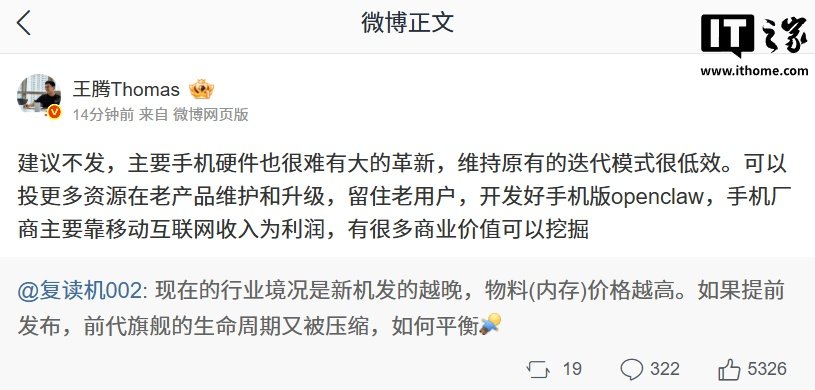
People in the industry say brands are in a difficult spot. If a new phone launches later, the underlying component bill—especially memory—may be even more expensive. But if a company releases devices too early, it shortens the lifecycle of the previous flagship generation.
IT Home highlighted comments from Wang Teng, founder of Yixiu Technology and formerly a senior Xiaomi and Redmi executive. His view was blunt: brands may be better off not pushing out new models so aggressively, because major smartphone hardware innovation is currently limited and the usual upgrade cycle is becoming inefficient.
Instead, he suggested companies put more resources into maintaining and upgrading older products, keeping existing users engaged, and improving a mobile version of OpenClaw. In his view, phone makers rely heavily on mobile internet revenue for profit, which means there is still plenty of commercial value to unlock beyond simply rushing new hardware to market.
Earlier the same day, IT Home also reported that the storage industry is entering what some are calling a golden period because of the ongoing memory price surge. One report said Samsung Electronics is close to selling out its planned memory chip production through next year.
To secure supply, enterprise customers are increasingly leaning toward long-term agreements with Samsung, and some companies have reportedly proposed five-year deals that would run all the way to 2030.
The pressure may not ease soon. At MWC 2026, Xiaomi Group partner and smartphone president Lu Weibing also addressed the issue and said this round of rising memory prices looks like a long cycle. His estimate was that the trend could last until the end of 2027, stretching for nearly three years from the second quarter of 2025 through late 2027.
If that forecast holds, higher smartphone prices may not be a short-term bump. Instead, they could become one of the defining realities for the mobile market over the next several product cycles.