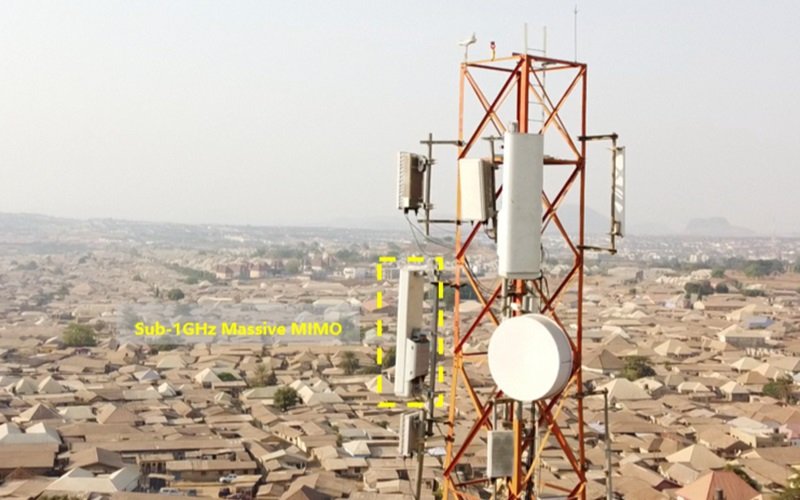
Huawei said it has completed the world’s first commercial Sub-1GHz Massive MIMO deployment with MTN Nigeria in Abuja, marking a notable milestone for low-band mobile network expansion in Africa.
According to Huawei, once the solution went live on the commercial network, low-band LTE traffic jumped 104%. Downlink user experience improved by 28% compared with the older 4T4R site setup, while PRB utilization dropped by 8%, pointing to a meaningful gain in capacity and a smoother 4G experience for users.
The company also said MTN has now completed the world’s first full-band Massive MIMO site by combining this low-band deployment with previously installed C-Band and mid-band Massive MIMO equipment. In practical terms, that gives the operator an early example of what Huawei calls an “All Bands to Massive MIMO” network approach.
Nigeria, Africa’s most populous country, is going through a major mobile-network transition as more subscribers move from 2G and 3G to 4G services. At the same time, usage from short video, live streaming, mobile payments, and other data-heavy services keeps climbing, which puts more pressure on limited spectrum resources.
Data cited from the Nigerian Communications Commission shows that as of January 2026, 4G accounted for 53.41% of all network connections in the country, up from 47.23% a year earlier. Over the same period, 2G and 3G continued to shrink. That shift helps explain why congestion on low-frequency bands has become a bigger issue for operators trying to maintain network quality.
To address that, MTN Nigeria and Huawei said they jointly deployed Sub-1GHz Massive MIMO. Compared with a 4T4R setup, the companies said the new system can double downlink LTE capacity. Looking further ahead, Huawei said that after the network evolves to NR, capacity could expand to as much as 3.2 times current levels, helping operators absorb suppressed demand and relieve congestion in busy areas.
Huawei described the technology as the first time large-scale antenna arrays and wideband techniques have been applied to low-band “golden spectrum,” covering 700MHz, 800MHz, and 900MHz ranges. The idea is to improve spectrum efficiency by coordinating fragmented low-band resources more effectively.
The company also referenced earlier commercial verification results, saying the product delivered five times the downlink capacity of traditional low-band 2T2R equipment, improved uplink coverage by 8dB, and raised uplink speed by four times. Huawei added that the coverage radius for maintaining a 20Mbps uplink experience could also be doubled.
Another point highlighted in the announcement is multi-standard support. The solution is designed to work alongside GSM, UMTS, LTE, NR, and NB-IoT, which should make it easier for operators to move toward 5G without abandoning existing network layers overnight.
Huawei said the commercial rollout became possible through combined advances in materials, architecture, and algorithms that helped solve long-standing low-band Massive MIMO challenges such as panel width, size, and weight. In other words, the company is positioning this as the missing piece needed to make full-band Massive MIMO practical at scale.
The deployment also fits into a broader relationship between the two companies. During MWC Barcelona 2026 in March, Huawei and MTN Nigeria signed a strategic cooperation memorandum focused on AI-driven network evolution, digital inclusion, and home broadband growth, with autonomous network L4 named as a shared direction. Earlier this month, the two companies also said they had completed sub-Saharan Africa’s first commercial 25Gbps full-duplex microwave link test to support high-speed 5G backhaul.