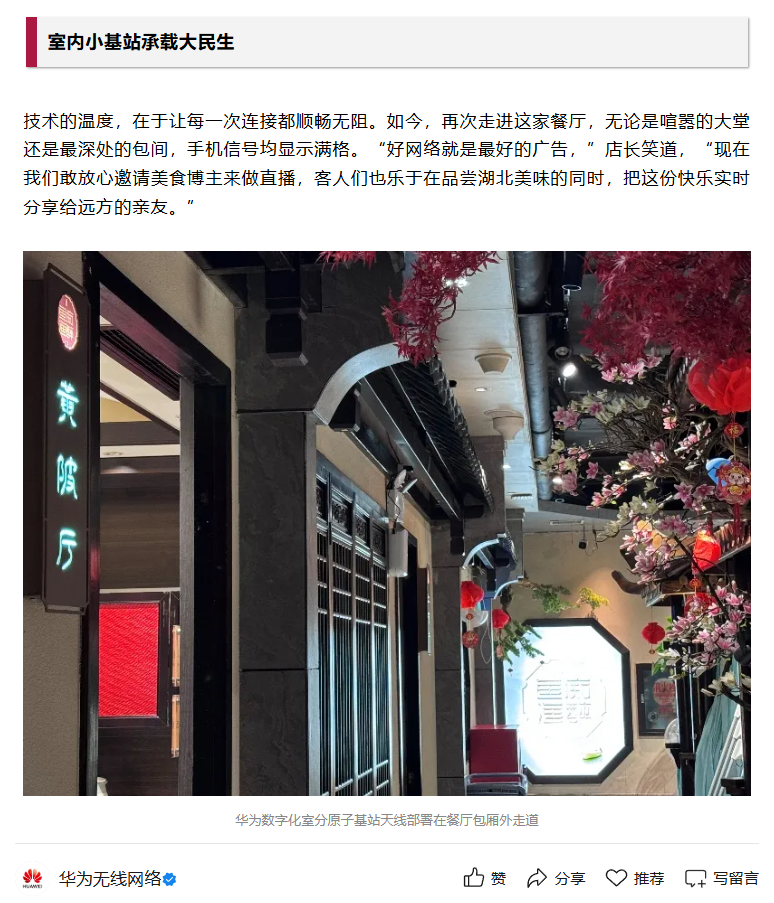
Huawei has introduced a new compact base station solution called Huawei iNCR, positioning it as a simpler way to fix weak indoor signal coverage in places where traditional deployments are slow, bulky, or expensive. IT Home says the system was recently used in Wuhan, where Hubei Mobile and Huawei upgraded wireless service inside a large restaurant with complex room layouts and thick walls.
The venue reportedly covers more than 2,200 square meters and extends over 50 meters in depth, making it a classic example of an indoor signal dead zone. After the iNCR deployment, Huawei says the site reached full signal coverage without interrupting normal business operations.
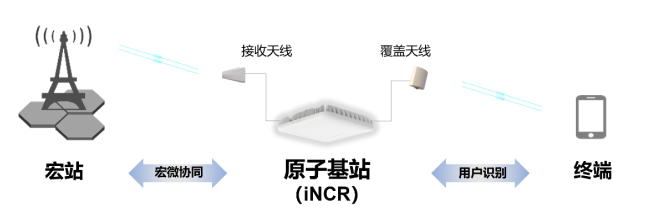
Huawei describes the setup as a digital indoor-distribution atomic base station solution that acts as an intelligent extension of a macro base station’s signal. Its main selling point is ease of deployment. The unit is about palm-sized, uses wireless transmission, doesn’t require fiber, and doesn’t need a SIM card to be configured on site.
That lighter setup is supposed to shorten installation time dramatically. Huawei says a single-point deployment that might take three days with a conventional solution can be finished in as little as three hours with iNCR. In the Wuhan restaurant example, engineers reportedly completed the installation within half a day.
The company is also pushing the reliability angle. Huawei says the hardware has gone through full life-cycle validation and claims the ten-year failure rate can be as low as two-thousandths, or less than one percent of what it describes as a traditional repeater’s failure profile. It also says the system can coordinate intelligently with macro base stations to improve energy efficiency.
Cost and capacity are another part of the pitch. Huawei says the solution delivers better value than traditional repeater setups while doubling capacity performance and preserving manageability for operators that need something practical in small or awkward indoor spaces.
The broader target clearly goes beyond restaurants. Huawei says elevators and underground parking structures remain stubborn coverage blind spots across China, with more than three million elevators and over sixty thousand underground parking facilities still needing signal enhancement. The company argues that iNCR is designed to tackle exactly those hard-to-cover indoor scenarios.