A new round of third-party testing is raising fresh questions about Exynos 2600 efficiency. According to results shared by tech outlet TechStation365, Samsung’s upcoming mobile chip reached peak power draw levels that look unusually high for a smartphone platform, even edging into territory more commonly associated with thin-and-light laptops.
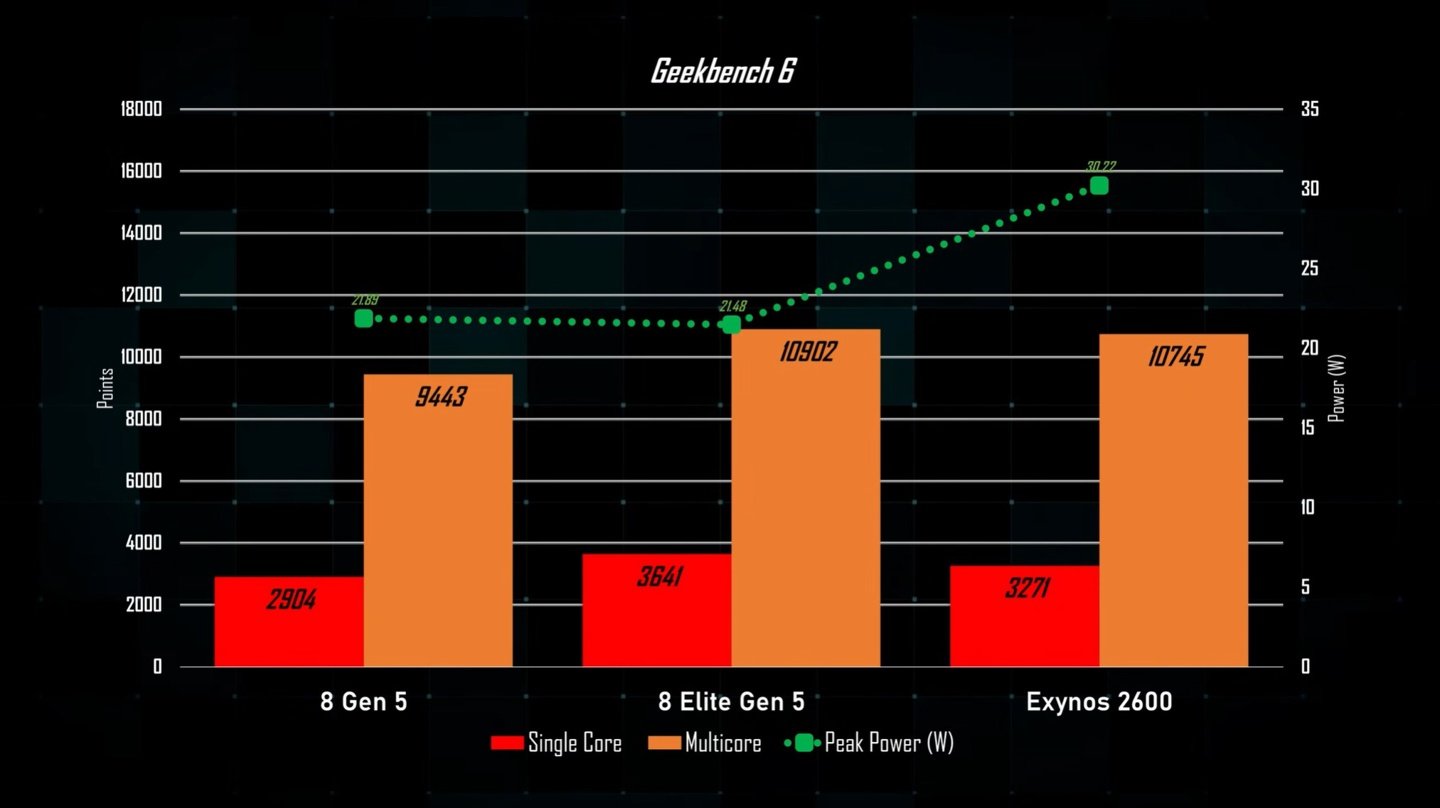
The report says a Galaxy S26 prototype powered by the Exynos 2600 pulled as much as 30.22W during Geekbench 6 testing. For comparison, the competing Snapdragon 8 Elite Gen 5, which is said to be built on TSMC process technology, reportedly peaked at 21.48W in the same type of benchmark run. That puts Samsung’s chip roughly 40% higher in peak power use.
What makes the comparison more awkward is that the efficiency trade-off doesn’t seem to come with a clear performance win. In the same report, the Exynos 2600 posted a single-core score of 3271, around 10% lower than its Snapdragon rival. Multi-core results were much closer at 10745, trailing by only about 1%, but still not enough to offset the much heavier power demand on paper.
The source also simulated a more practical workload by extracting a 20GB compressed file. In that test, the Exynos 2600 reportedly hit 13W, while the two Snapdragon chips used for comparison both stayed below 5W. The Samsung chip was said to consume around 63% more power in that scenario and still took longer to finish the task.
If those numbers hold up, they could become a serious concern for real-world thermals. Smartphone chips don’t have the cooling headroom that laptops do, so a design that briefly peaks above 30W may end up relying heavily on throttling once sustained workloads kick in. That matters not just for benchmarks, but also for gaming, camera processing, and on-device AI features that can keep a chip under pressure for longer stretches.
Of course, this is still early testing rather than Samsung’s own final performance guidance, so there’s room for things to change before commercial devices arrive. Even so, the report paints a picture of a chip that may be struggling to balance power and efficiency as mobile silicon keeps pushing toward more ambitious performance targets.