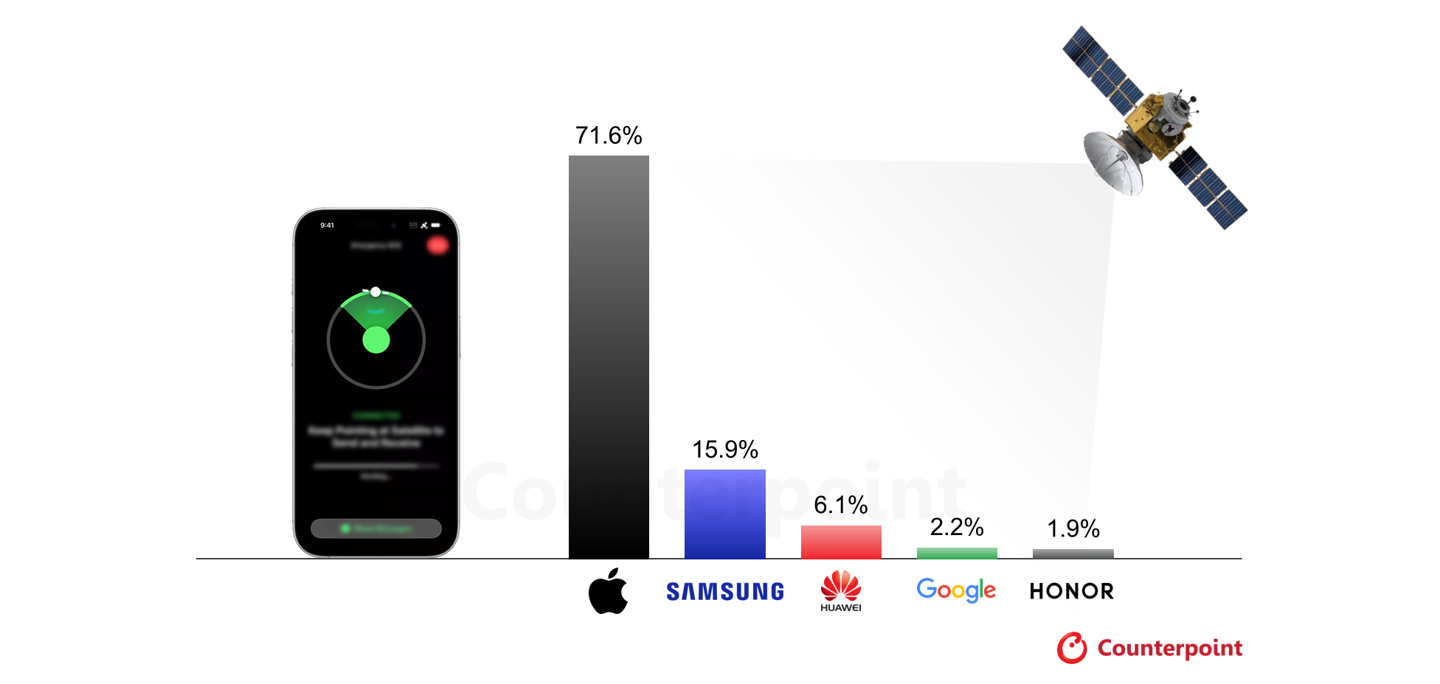
A new report from Counterpoint Research says satellite connectivity is moving out of the experimental stage and into a real growth phase for the smartphones market. By 2030, the firm expects about 46% of global smartphone shipments to support non-terrestrial networks, or NTN.
In the near term, the market is still expected to be led by vendor-specific solutions rather than a fully mature cross-industry standard. Counterpoint says 3GPP NTN still faces several bottlenecks, including chip readiness, operator certification, and broader service maturity, so adoption won’t be completely friction-free just yet.
Apple was the first brand to push satellite features into a mainstream smartphone when it introduced the capability on the iPhone 14 in partnership with Globalstar in 2022. Huawei followed in 2023, becoming the second major phone maker to bring similar support to its devices. According to the report, more than 10 brands now offer some form of satellite-enabled functionality in phones.
For now, most of that activity is still concentrated in premium devices. The bigger barrier to mass adoption isn’t just hardware cost, but the lack of a true must-have everyday use case. At the moment, features based on 3GPP Release 17 are still centered mostly on SOS and messaging. Counterpoint expects Release 18 to help expand uptake among more high-end brands, while wider mainstream and midrange adoption may need to wait until Release 19 matures the ecosystem further.
The report also highlights rising competition among chipset vendors. Qualcomm remains one of the most visible players in the Android ecosystem through modem platforms like the Snapdragon X80 and X85, while Huawei, Google, and Samsung are also advancing their own support strategies. MediaTek is pushing NTN integration through its MT6825 5G SoC, and Counterpoint believes more chip vendors entering the field should intensify competition while helping the market scale faster.
Regionally, North America is still out in front, largely because telecom operators and satellite companies there have already lined up several notable partnerships. The report points to T-Mobile and SpaceX, AT&T and AST Mobile, Rogers and SpaceX, and Apple and Globalstar as examples of how carrier-side collaboration is helping move satellite services closer to real consumer adoption.
Counterpoint vice president Peter Richardson says nearly half of all smartphones could support satellite links by the end of the decade, with Apple, Google, and Samsung likely leading on total penetration. He also argues that broader adoption will depend heavily on more Android brands, plus carriers outside the most developed markets, bringing practical satellite services to a wider base of users.