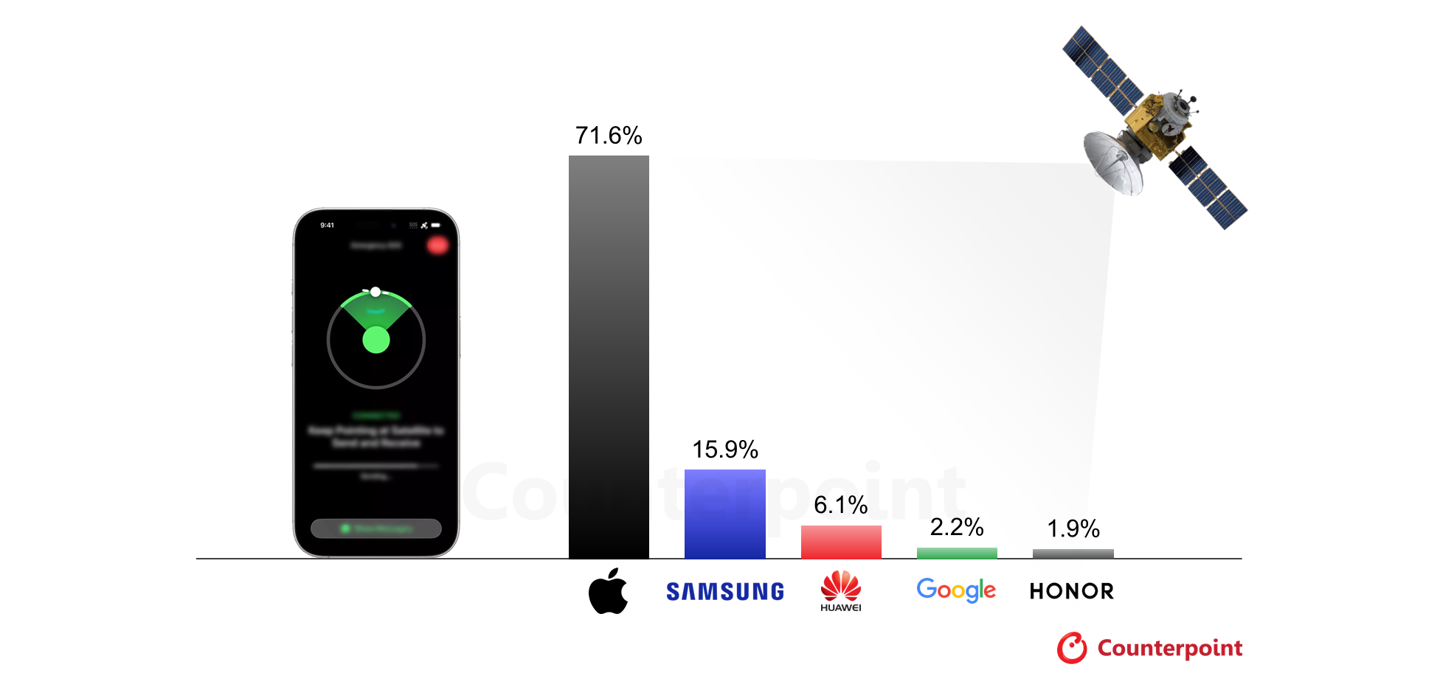
Counterpoint Research says satellite connectivity is moving into a real growth phase, and it now expects 46% of global smartphones shipped by 2030 to support non-terrestrial network, or NTN, features.
In the near term, the firm expects most of that momentum to come from proprietary solutions built by individual companies rather than fully mature industry-standard deployments. It says 3GPP NTN still has work to do across chip readiness, carrier certification, and service maturity before the technology becomes broadly seamless.
Apple was the first major brand to push satellite features into mainstream smartphones when it launched the capability on the iPhone 14 in partnership with Globalstar in 2022. Counterpoint says more than 10 brands now offer some form of satellite support, and Amazon’s recent acquisition of Globalstar could expand the business opportunity around connectivity services even further.
For now, high-end devices are still doing most of the heavy lifting. Counterpoint argues the biggest obstacle to mass-market adoption isn’t awareness but the lack of a true killer use case. Features based on 3GPP Release 17 are still mostly limited to SOS and messaging, while Release 18 is expected to help more premium brands move in. Broader midrange adoption may have to wait until Release 19.
Senior analyst Shivani Parashar says Qualcomm remains out front among Android chip suppliers through the Snapdragon X80 and X85 modems, while Huawei, Google, and Samsung are also moving ahead. MediaTek, meanwhile, is pushing NTN integration through its MT6825 5G platform. Counterpoint believes more chipmakers entering the space will intensify competition and help the market scale faster.
North America is still leading because carriers and satellite operators there have already formed multiple partnerships, including T-Mobile with SpaceX, AT&T with AST Mobile, Rogers with SpaceX, and Apple with Globalstar. Counterpoint vice president Peter Richardson says Apple, Google, and Samsung are likely to lead overall penetration, while lower-priced Android brands may take longer to catch up unless more carriers outside developed markets launch satellite services.