At this week’s SID Display Week event in the US, Samsung used its showcase to highlight two eye-catching display concepts aimed at future mobile devices.
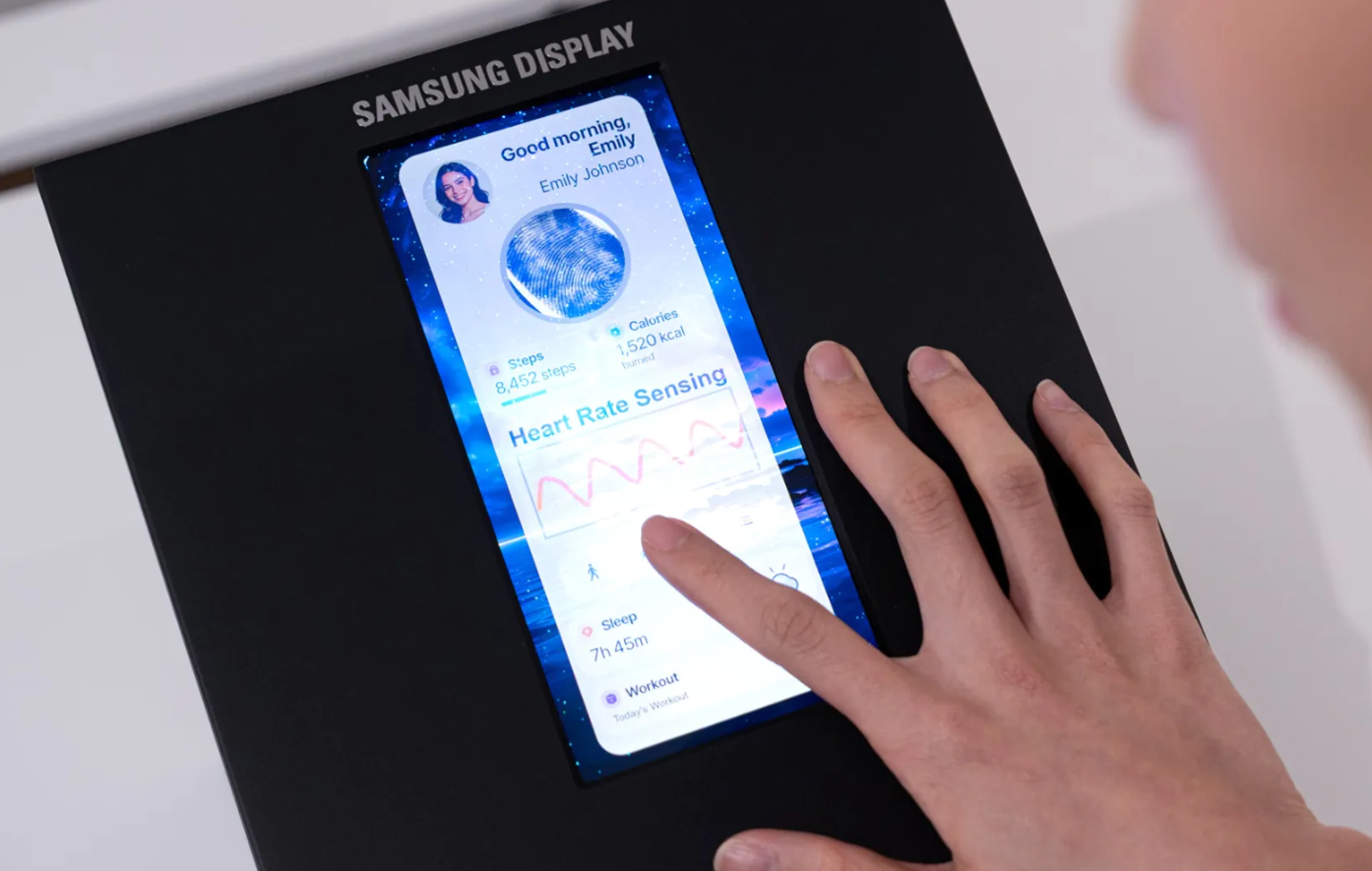
One of the standout demos was Sensor OLED, a panel design that combines OLED pixels with organic photodiodes in a single layer. According to Samsung, that makes it possible for the display itself to handle biometric measurements such as heart rate and blood pressure phone display sensing without relying on a separate stacked sensor structure.
The company also said the updated version reaches 500 PPI, which is 33% higher than last year’s version. Samsung paired that with its Flex Magic Pixel technology, a form of privacy viewing control that can selectively hide sensitive information when the screen is viewed from the side.
Samsung also introduced its Flex Chroma Pixel display, which uses next-generation light-emitting materials including phosphorescent-sensitized fluorescence, or PSF, together with the company’s own polarizer technology. The result, according to Samsung, is a highly efficient bright display capable of peaking at 3,000 nits while covering 96% of the ITU BT.2020 color gamut.
Beyond those two concepts, Samsung said it would also show an EL-QD prototype that reaches up to 500 nits, a 25% improvement over last year, along with a 200 PPI stretchable Micro LED display designed for automotive dashboards.