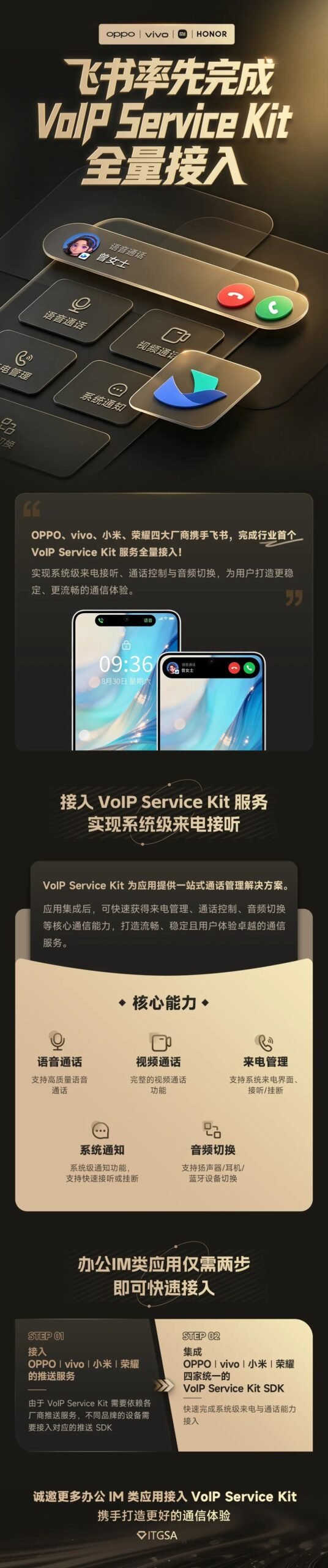
Feishu Android CallKit is getting much closer to the native calling experience people expect on modern phones. China’s Mobile Intelligent Terminal Ecosystem Alliance announced that Feishu has now completed full integration with the VoIP Service Kit frameworks offered by OPPO, vivo, Xiaomi, and Honor.
In practical terms, that means Feishu can present incoming internet calls at the system level on supported phones, rather than feeling like a delayed in-app alert that depends on whether the app is already active in the foreground. Users can answer calls more naturally, control the call through system interfaces, and switch audio routes more smoothly.
The alliance originally introduced VoIP Service Kit in August 2025 as a vendor-side framework for internet calling apps. One of its main jobs is to let a push message wake an app when it is not currently running, so the app can still surface a call invitation promptly. That solves a long-running Android problem where background restrictions often make third-party calling apps feel less reliable than normal phone calls.
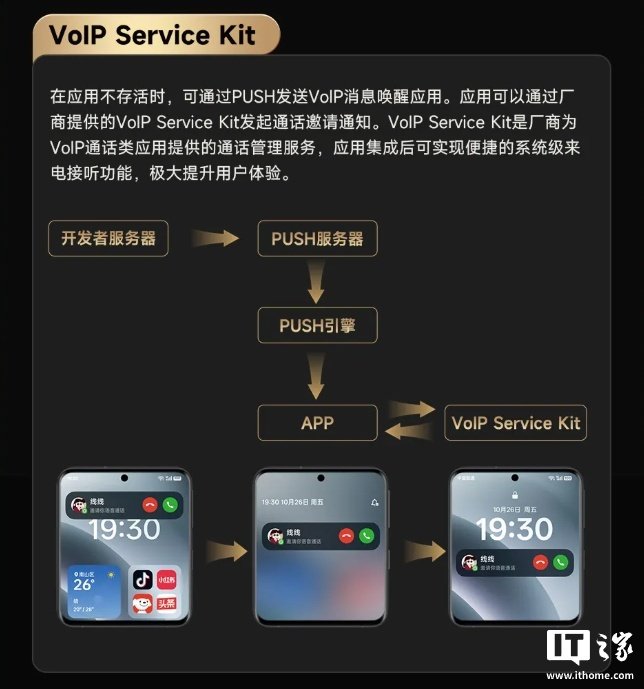
According to the announcement, Feishu is the first app in the industry to complete full access across all four major Android brands named in the release. With that in place, the app can now support system-level incoming-call pickup, call controls, and audio switching on phones from OPPO, vivo, Xiaomi, and Honor.
This matters because business communication apps live or die by responsiveness. If users miss calls because the app was suspended, delayed by background management, or unable to trigger a proper incoming-call screen, the experience quickly starts to feel untrustworthy. A deeper system-level VoIP calling path makes the service feel much closer to a built-in dialer workflow.
The broader context is that phone makers have increasingly been creating official interfaces for this kind of feature. Apple has long offered a similar path on iPhone, and Huawei has also rolled out related support for third-party apps. The move by these Android brands shows the same idea is becoming a standard expectation rather than a niche enhancement.
For enterprise users, the benefit is simple: fewer missed calls, cleaner answer and handoff behavior, and a more familiar calling experience even when the conversation is happening over the internet instead of the cellular network. For app developers, the news is also a signal that vendor-backed VoIP frameworks are now important enough to shape how communication apps compete on Android.