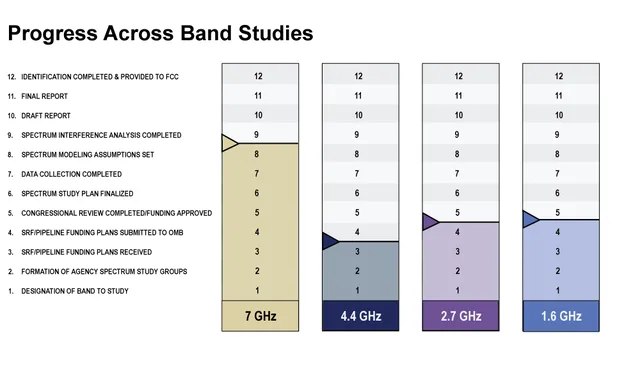
The US government’s push to line up more 6G spectrum is starting to take clearer shape. This week, the National Telecommunications and Information Administration, or NTIA, shared fresh progress updates covering four separate frequency ranges, with work on the 7GHz band currently the furthest along.
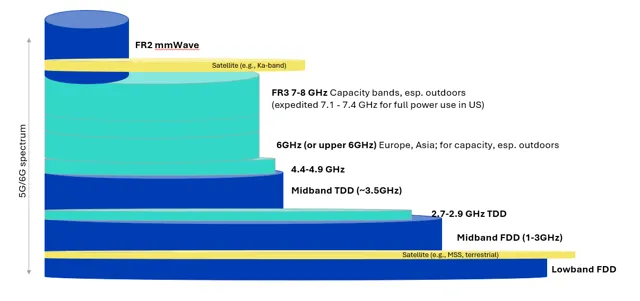
The effort traces back to a memorandum signed by Donald Trump last December that framed spectrum planning as part of a broader race to stay competitive in 6G. Under that directive, NTIA was asked to study the lower 7GHz range from 7125MHz to 7400MHz over the course of one year, while also exploring whether existing federal users could be shifted into other ranges, potentially somewhere in the 7.4GHz to 8.4GHz window.
The same memo also told NTIA to keep work moving on the 2.7GHz band, spanning 2700MHz to 2900MHz, and the 4.4GHz band, covering 4400MHz to 4940MHz. On top of that, the agency is reviewing the 1.6GHz range from 1675MHz to 1695MHz as another possible mobile communications candidate.
NTIA this week launched Spectrum.gov as a public-facing hub for those updates. The site is meant to show where 6G-related spectrum studies stand, while also covering adjacent policy work tied to satellite communications and preparation for the 2027 World Radiocommunication Conference, better known as WRC-27.
Speaking at a CTIA summit on May 6, NTIA administrator Arielle Roth said the agency is making solid progress on identifying spectrum in the 7GHz band. She said the technical work is ongoing and that a final report is on track for December.
For the 2.7GHz range, the next step depends on Congress approving use of the Spectrum Relocation Fund. Lawmakers have 54 days to decide. Roth said NTIA is hoping for approval so the band can move toward auction more quickly. According to the report, two major federal users in that range are NOAA and the FAA.
In the 4.4GHz band, NTIA has already started reviewing plans submitted by nine affected agencies and military departments. For the 1.6GHz band, Congress is expected to make a decision by June 9 on the related pipeline plan, which would then let agencies begin preparations and field testing to evaluate whether the spectrum is practical for mobile use.
Carriers and vendors aren’t waiting on the sidelines, either. T-Mobile has already received FCC authorization to test Nokia experimental radio gear in the 7125MHz to 7525MHz range. Equipment makers are increasingly pointing to roughly 7GHz to 20GHz as the future mid-band sweet spot for 6G. Ericsson has also completed a pre-standard over-the-air test in 7GHz spectrum using 400MHz bandwidth, with a focus on uplink performance, energy efficiency, and spectrum utilization.
China, meanwhile, is moving quickly on its own 6G spectrum roadmap. On May 8, the Ministry of Industry and Information Technology approved test use of the 6425MHz to 7125MHz range for the IMT-2030, or 6G, promotion group, making China the first country to formally approve trial frequencies for 6G work.
Omdia analyst Gabriel Brown said the US 6G spectrum picture currently looks fairly encouraging. The FCC is also preparing two spectrum auctions, with AWS-3 expected to begin in June and an upper C-band auction slated to be completed no later than July 2027. Taken together, the latest NTIA update suggests the US is still early in the process, but the policy groundwork is becoming much more concrete.