MediaTek held its Dimensity Developer Conference 2026, or MediaTek MDDC 2026, with a theme centered on bringing intelligent computing across more devices and usage scenarios. The company used the event to introduce new developer tools, updated AI frameworks, and a broader vision for turning its Dimensity ecosystem into a foundation for more proactive and connected user experiences.
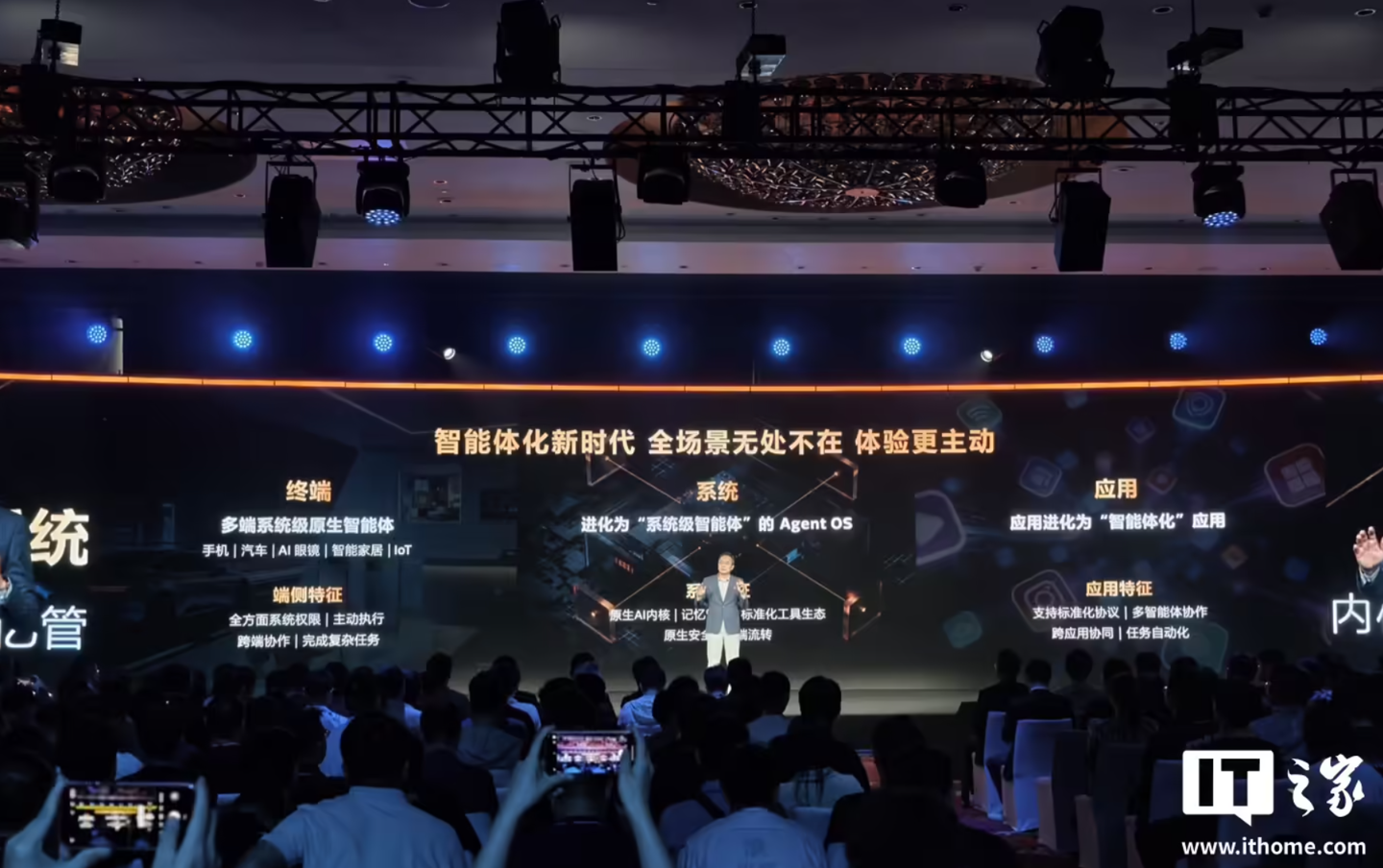
At the conference, MediaTek Director, General Manager, and COO Chen Guanzhou said agentic AI is reshaping a growing number of industries and application scenarios. He said the company wants to combine its full-stack portfolio across phones, cars, IoT, and AI infrastructure with cloud-side acceleration so partners can move more efficiently from concept to scaled deployment and from technical value to commercial value.
MediaTek also shared a few growth metrics for its ecosystem. Over the past three years, the company said partner growth in the Dimensity AI ecosystem rose 240%, while downloads of its Dimensity AI development kit increased 440%. In plain terms, MediaTek is trying to show that its AI platform is no longer just a chip story. It wants developers, device brands, and service partners building on top of it at scale.
The biggest product announcement on the AI side was the release of the Dimensity AI Agentic Engine 2.0. MediaTek says the platform uses its SensingClaw technology to deliver always-on sensing with lower power consumption, giving device makers a way to build more proactive Agent OS experiences that can recognize context, trigger actions, and work across apps instead of staying trapped inside a single interface.
During the event, MediaTek also showed native system-level Claw integrations developed with OPPO, Xiaomi, and Transsion. The demos focused on proactive perception, proactive execution, and smoother cross-device handoff while still emphasizing on-device privacy protection and data security.
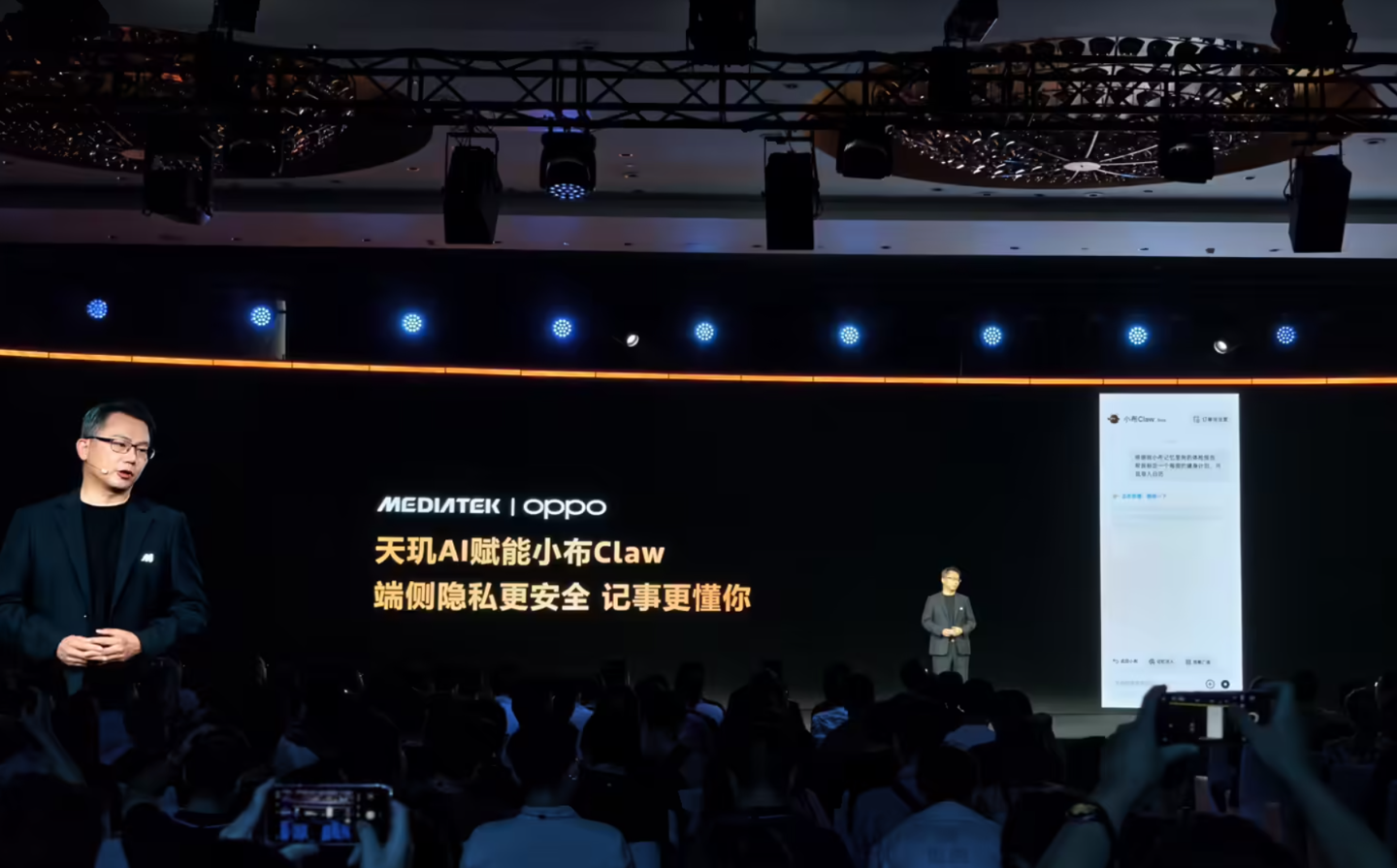
Another major update was the launch of the Dimensity AI Development Kit 3.0, which expands multimodal capabilities for on-device agents and is meant to speed up deployment of AI workloads directly on end-user hardware. MediaTek highlighted several additions here:
First, a visual deployment path for LVM models replaces command-line-heavy workflows with a GUI-based modular setup, and the company says that can improve deployment and tuning efficiency by as much as 50%.
Second, a new low-bit compression toolkit is designed to reduce memory usage during generative AI model compression, with MediaTek claiming compression efficiency gains of up to 58% at the same quality level.
Third, a new eNPU development toolkit is intended to help developers take fuller advantage of the power-efficient NPU blocks inside Dimensity chips, with the company saying always-running lightweight AI models can cut power use by 42%.
Fourth, MediaTek AI Partner is being positioned as an easier conversion assistant for deploying models on Dimensity platforms, with the company saying it can reduce on-device LLM deployment time by as much as 90%.
Beyond AI, MediaTek spent a lot of time on gaming. The company said its continuously updated Dimensity mobile platforms, StarSpeed Engine gaming stack, and Dimensity Profiler tools are aimed at helping developers deliver more immersive titles while making better use of CPU and GPU resources.
One of the more technical gaming announcements involved a Ray Tracing Pipeline solution for mobile. MediaTek says the setup can bridge PC and mobile rendering pipelines, letting developers reproduce more complex lighting, shadows, dynamic objects, skeletal animation, and even off-screen reflections with better accuracy in real time. The company said it is collaborating with the team behind Delta Force on forward-looking RTP work intended to improve visual realism for players.
MediaTek also said it has been working with Unity China on deep adaptation for Virtual Geometry technology. According to the company, that allows more than one billion triangles to be rendered on mobile while sustaining a full-frame experience for an hour at 1.5K resolution. If those claims hold up in real shipping games, that would represent a meaningful step toward richer AAA-style visuals on phones.
Audio latency got attention too. MediaTek said its Dimensity LE Audio low-latency technology can deliver 32ms lower Bluetooth stereo latency on flagship Dimensity platforms through full-link optimization. The technology has already landed in a Peacekeeper Elite test build, where the goal is tighter sync between sound and action in competitive play.
On the GPU side, MediaTek highlighted a Dynamic Cache architecture that allows the GPU to coordinate system cache and memory access at the same time, helping developers move critical game data through cache when appropriate, reduce bandwidth demand, and improve power efficiency. The company said titles such as Counter-Strike: Future and Arena Breakout have already used the approach to sustain smooth frame rates while using less bandwidth and power.
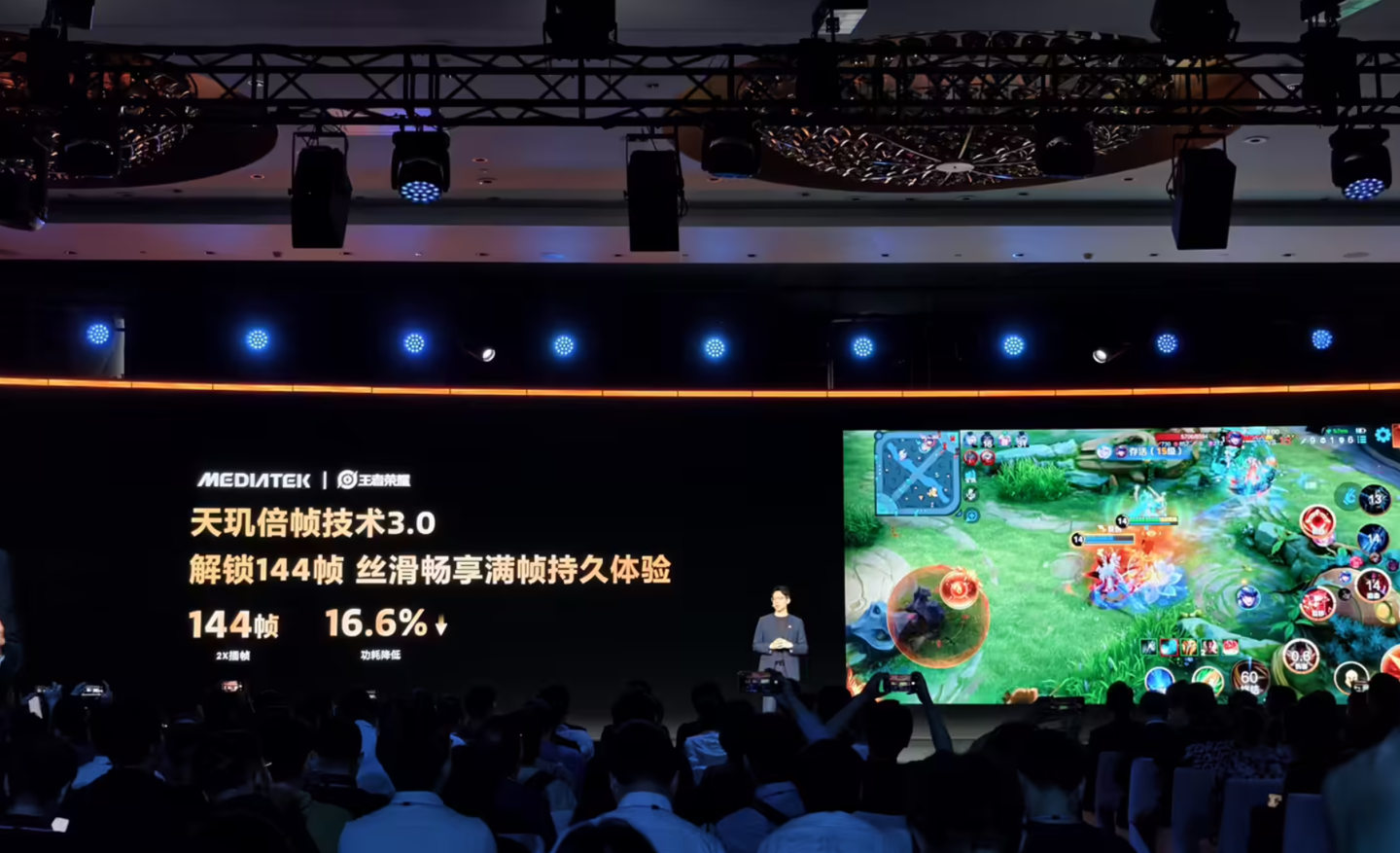
StarSpeed Frame Rate technology 3.0 was another update. MediaTek says the latest version adds options such as Depth-based prediction, broader plugin support for engines including Unreal Engine and Unity, support for 144Hz and 165Hz modes, compatibility across phones, tablets, and cockpit platforms, and support for hot updates during game maintenance. The company cited Honor of Kings and Arknights: Endfield as examples of games benefiting from smoother playback and lower power draw.
MediaTek also introduced Adaptive Control 5.0, adding intelligent frame regulation and scene prediction so games can schedule compute resources more precisely based on what is about to happen next on screen. The company said Wuthering Waves has already shown improvements in 1% low frame performance and power metrics with the new version.
Finally, MediaTek previewed Dimensity Profiler 2.0 for Android game developers. The update adds full CPU call stack tracing, platform MIPS load monitoring, and GPU bandwidth indicators. According to MediaTek, a number of popular games already use Dimensity Profiler for routine performance debugging and automated testing, and applications for the tool are now open through the company’s developer portal.
Put together, MediaTek MDDC 2026 wasn’t just a routine chip-partner event. It was a broad attempt to show that MediaTek wants its platforms to power the next wave of agentic AI experiences while also giving developers more practical tools for deploying on-device models and optimizing demanding mobile games.