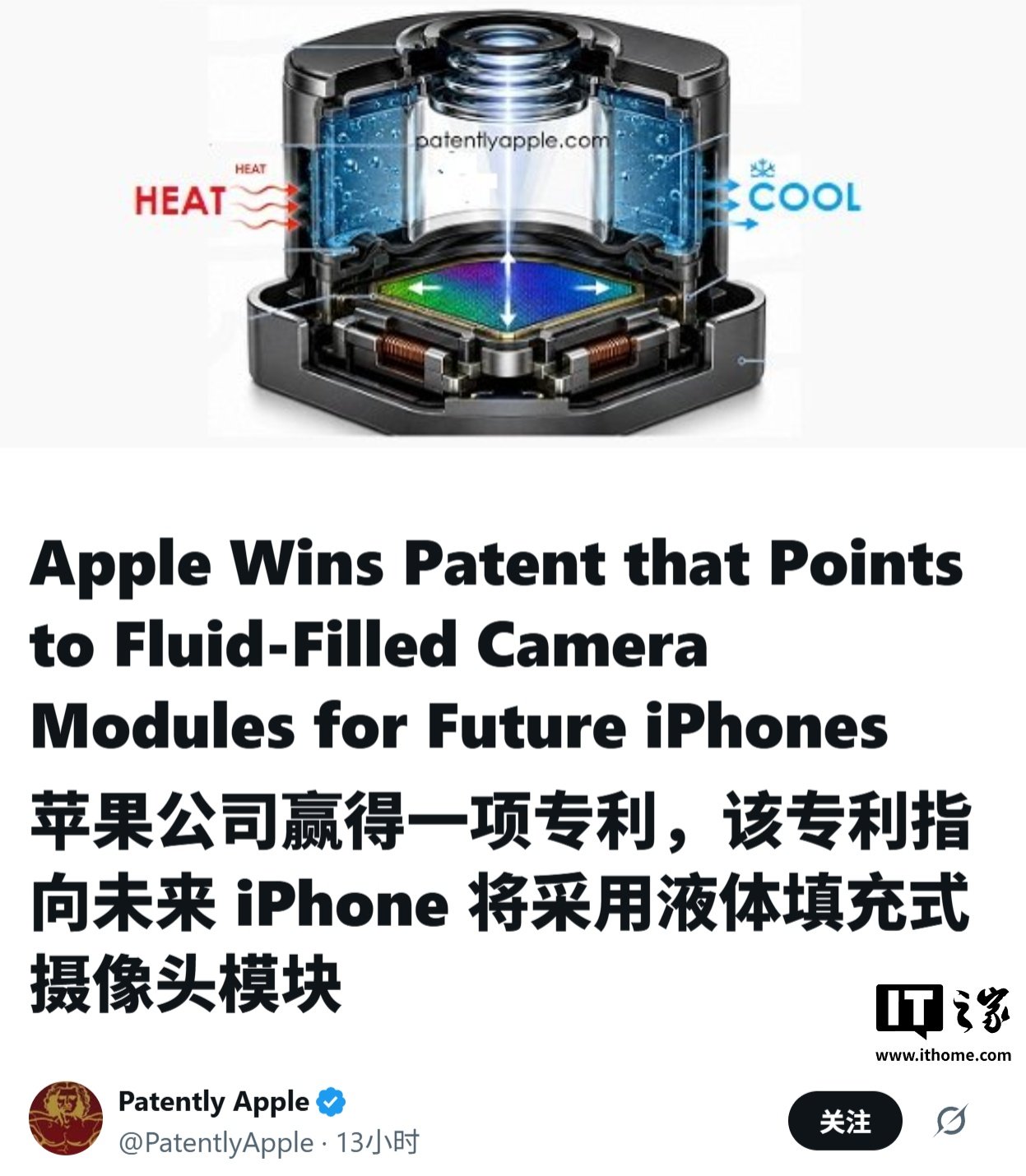
Apple has been granted a new patent for a camera module cooling system that uses a dielectric liquid to absorb waste heat from the image sensor, actuators, and other electronics inside the device. The patent was spotted and reported by PatentlyApple.
Modern iPhone cameras handle demanding computational workloads such as high-frame-rate video recording, computational photography, ProRes encoding, Spatial Video capture, and advanced autofocus. This performance creates substantial thermal loads inside the small camera housing. Apple’s new patent is specifically designed to tackle heat dissipation in compact mobile camera enclosures.
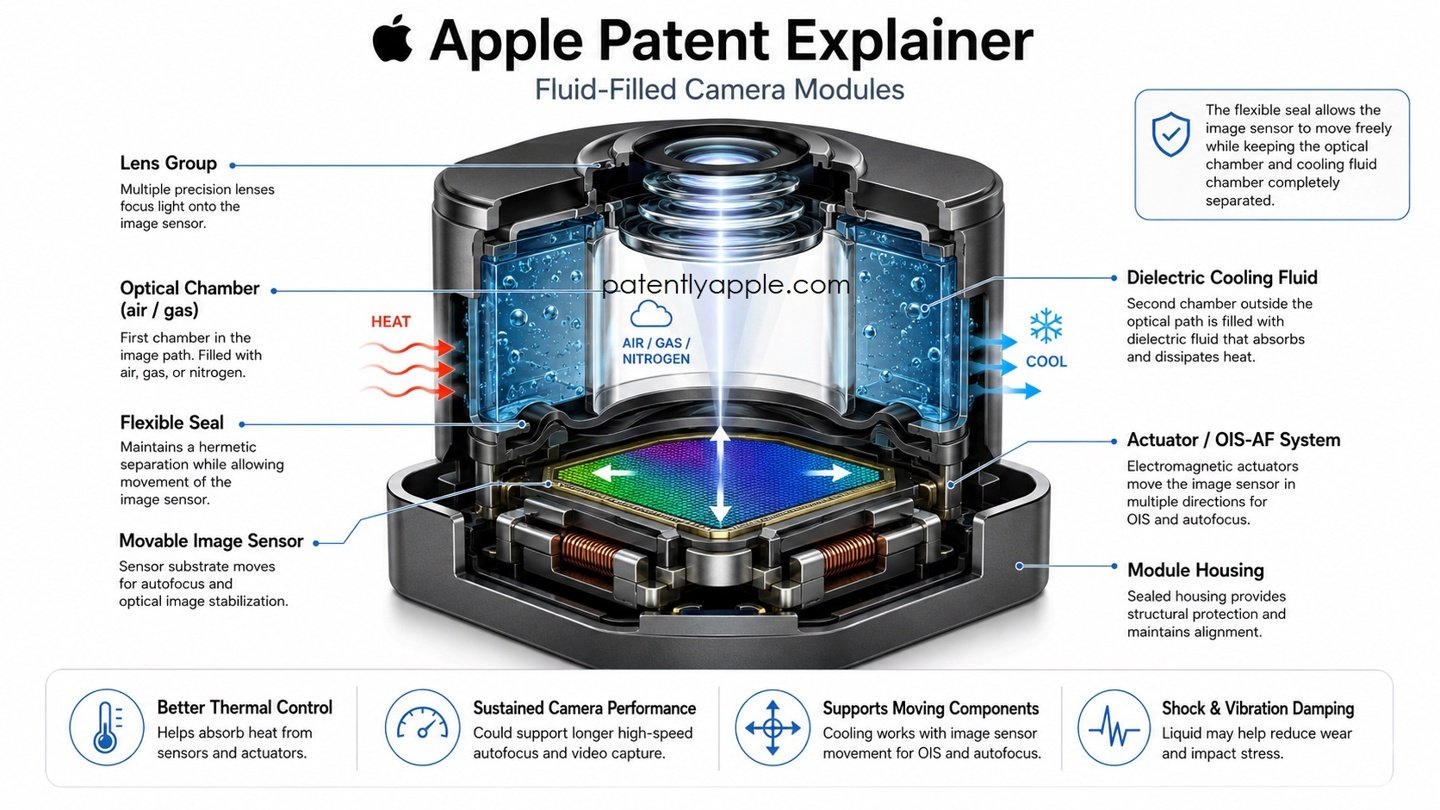
The patent outlines a design featuring a housing, lens elements, a movable substrate, an image sensor, and a flexible seal. Crucially, the flexible seal divides the interior space into two chambers: one along the optical path between the lens and the image sensor, and another outside of it, which holds the dielectric liquid. The use of a dielectric (non-conductive) liquid allows it to sit close to active electronics without causing short circuits.
According to reports, the reason for this divided chamber design is that the optical path of the camera must remain clean, stable, and completely dry. If the cooling liquid entered the space between the lens and the image sensor, it would degrade image quality, disrupt refraction, and interfere with focus. By confining the liquid to the non-optical area, Apple can dissipate heat effectively while maintaining pristine image quality.
Furthermore, the patent highlights how this design accommodates optical image stabilization (OIS) systems. Since modern OIS requires the image sensor to shift, tilt, or move along the optical axis, a rigid heat sink would restrict these micro-movements. The flexible seal and liquid-cooled design ensure that the iPhone camera module can cool down without restricting sensor movement or locking mechanical parts in place.