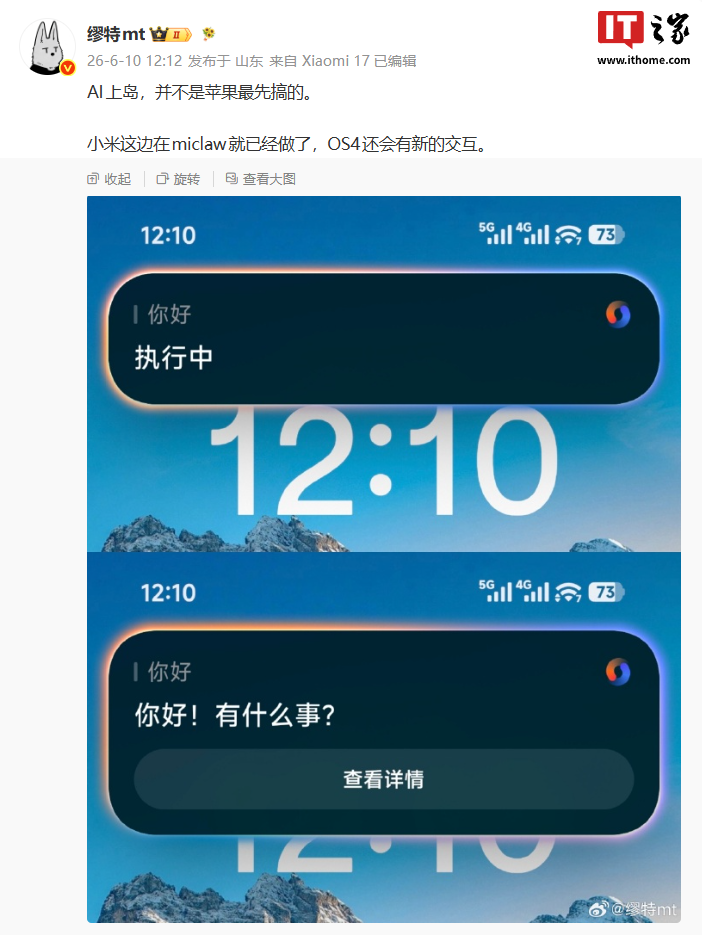
Xiaomi appears to be testing a more visible, system-level role for its AI assistant work, with Xiaomi miclaw shown using a Dynamic Island-style interaction before Apple’s newly demonstrated Siri AI experience becomes widely available.
Blogger @缪特mt said that Apple was not the first company to explore the idea of bringing an AI assistant “onto the island.” The blogger shared examples of Xiaomi miclaw using that kind of interface and added that HyperOS 4 is expected to bring more new interaction designs.
The report follows another post from blogger @数码闲聊站, who said an upcoming domestic operating-system update would place an AI voice assistant into an island-style interface. In the comments, the blogger said the feature had already been developed before Apple announced iOS 27.
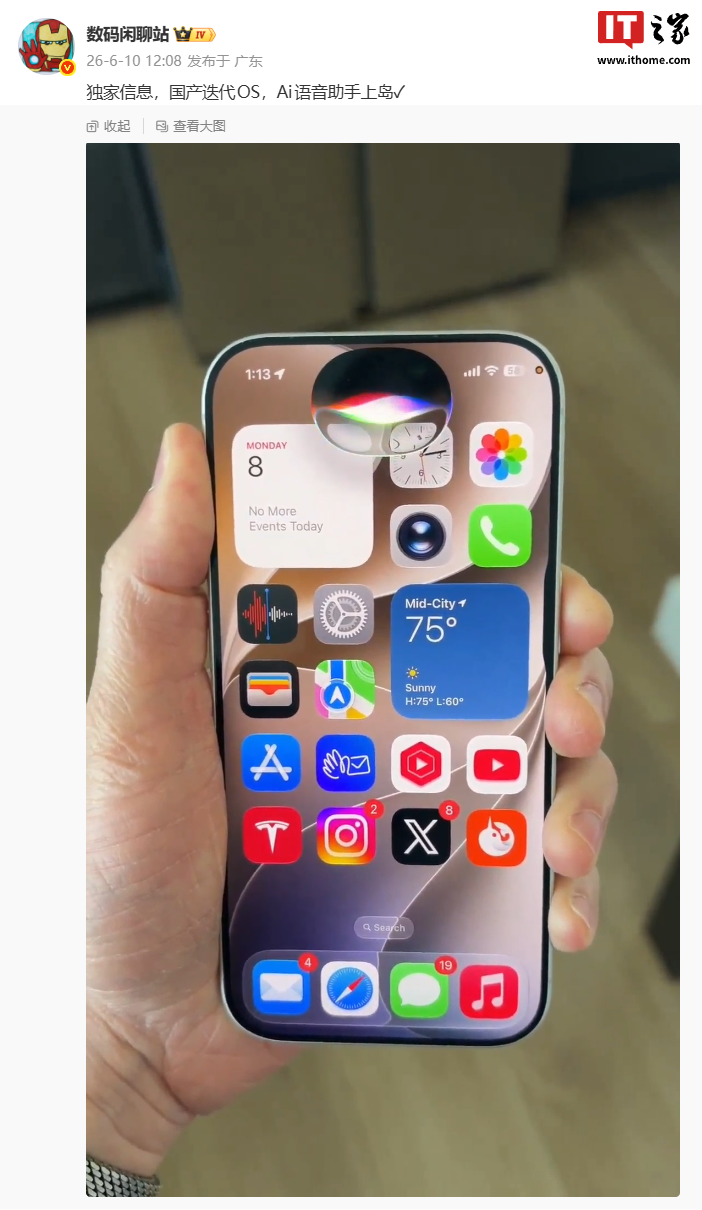
Apple’s version, shown during WWDC 2026, brings Siri AI into the Dynamic Island area. Apple’s demo shows Siri appearing in a large bubble and handling tasks such as answering questions, setting reminders, playing music, searching photos, understanding screen content, and starting navigation.
Xiaomi’s approach is tied to miclaw, an AI interaction test product built on the company’s MiMo large model. The project began a small closed test on March 6, 2026, aimed at technology enthusiasts and advanced users.
The core purpose of Xiaomi miclaw is to test how a large model can execute actions across Xiaomi’s “Human x Car x Home” ecosystem. That makes it broader than a simple chatbot and closer to an AI assistant designed to control services, devices, and workflows.
Xiaomi expanded the miclaw closed test on April 21, 2026. The test grew beyond phones and tablets to include PC, Mac, and display-equipped smart speakers such as the Xiaomi Smart Home Screen 11.
That multi-device support is important. If Xiaomi can make the same assistant experience work across phones, computers, and smart-home screens, the island-style interface becomes only one part of a larger cross-device AI strategy.
Xiaomi Group partner and president Lu Weibing also clarified on May 16, 2026, that Xiaomi miclaw is not meant to replace the existing Xiaoai assistant outright. Instead, the plan is to combine miclaw’s capabilities with “Super Xiaoai,” strengthening the assistant that Xiaomi users already know.
For U.S. readers, the most interesting part is not whether Xiaomi or Apple used the visual idea first. The bigger shift is that phone makers are moving AI assistants out of separate apps and into persistent system surfaces where users already look for live information.
If the rumors around HyperOS 4 prove accurate, Xiaomi’s next software cycle could make AI feel more integrated into everyday device control, especially across its phone, PC, and smart-home ecosystem.