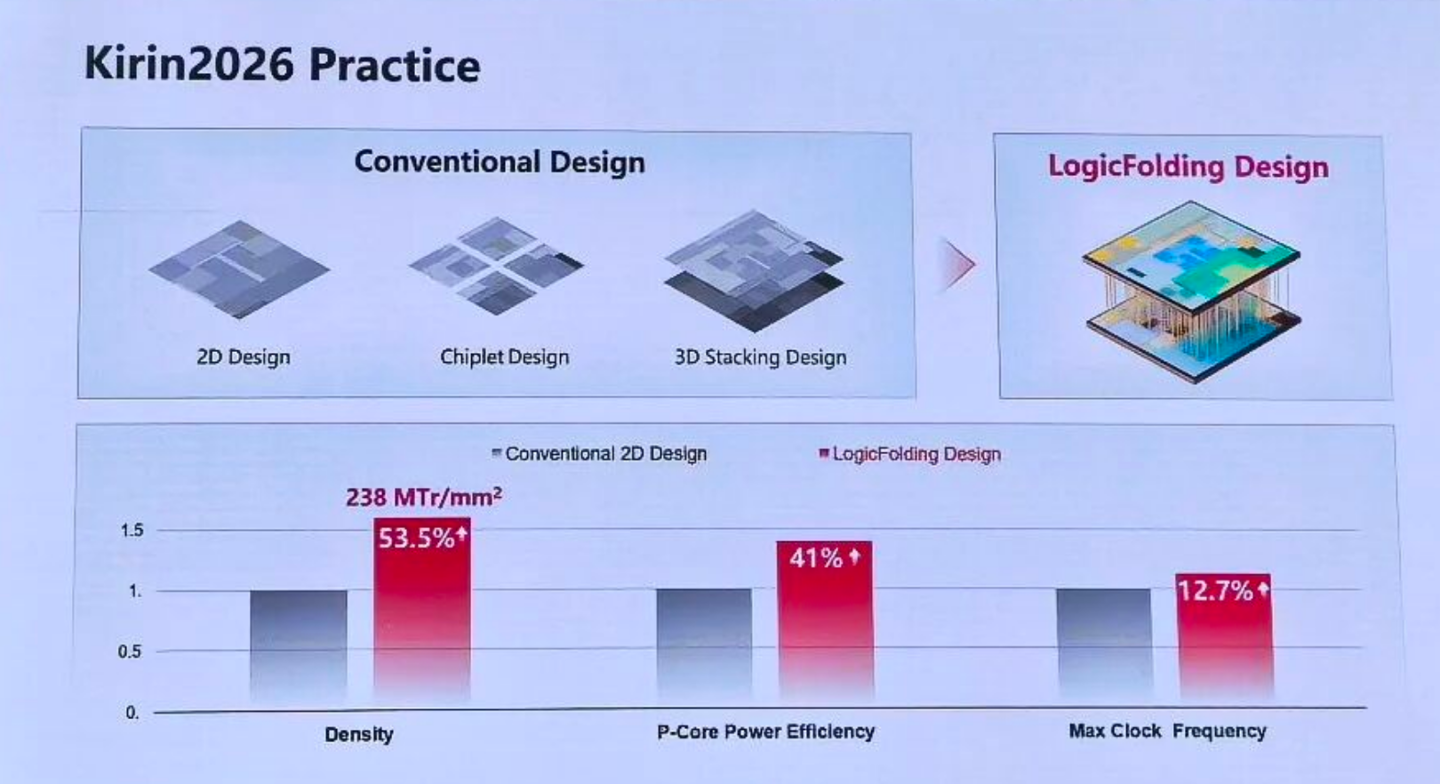
Huawei used ISCAS 2026 to preview what it says will be a major step forward for its next in-house mobile silicon. During the event, He Tingbo, Huawei board member and president of the company’s semiconductor business, said the upcoming Huawei Kirin 2026 phone chip will be the first to adopt LogicFolding technology and is set to arrive this fall.
According to slides shown during the presentation, the new chip delivers a 53.5% increase in transistor density over a traditional 2D chip design, reaching 238 MTr/mm². Huawei also said the performance core gains 41% in power efficiency, while peak clock speed rises by 12.7%.
Another slide outlined Huawei’s longer-term roadmap under what it calls the tau-law track. For 2026, that roadmap points to a 3.1GHz prime core. That number lines up neatly with earlier IT Home reporting on the Kirin 9030 Pro, which runs at 2.75GHz. A 12.7% boost from that baseline lands almost exactly at 3.1GHz.
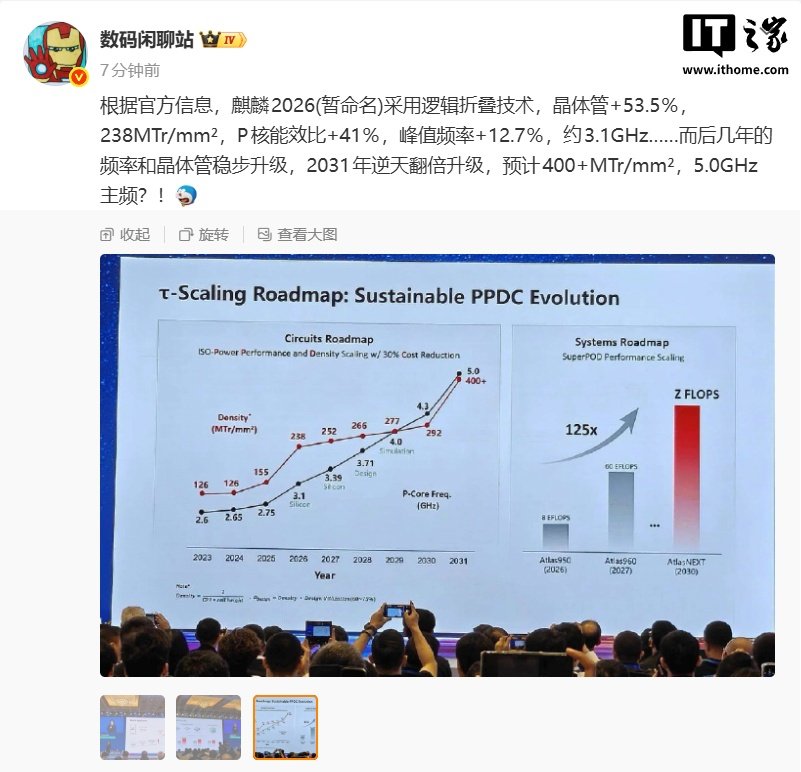
Huawei also suggested that both clock speeds and transistor density should continue climbing in the years ahead. By 2031, the company expects chip designs on this path to move past 400 MTr/mm² in transistor density and reach a 5.0GHz main frequency.
At this stage, Huawei still hasn’t given the chip an official retail name, and a lot can change before launch. Even so, the presentation offers one of the clearest official hints yet that the next Huawei Kirin 2026 platform is being positioned around denser layouts, better efficiency, and a notable jump in peak frequency.