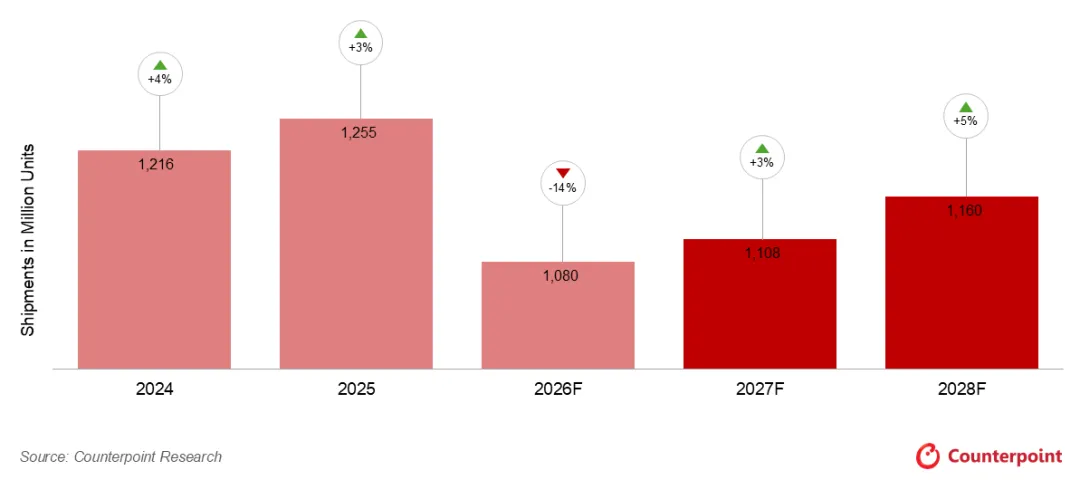
The global smartphone market is entering a highly challenging adjustment phase, according to the latest market outlook tracker report from Counterpoint Research. In a sharp downward revision, global smartphone shipments for 2026 are now projected to drop 13.9% year-on-year to approximately 1.08 billion units. This represents a historic annual low since 2013, surpassing the firm’s previous forecast in February which estimated a 12.4% contraction.
According to Counterpoint, a severe supply constraint in key memory components is the primary driver behind this downturn. The shortage has arisen as memory manufacturers aggressively reallocate their production capacity toward high-bandwidth memory (HBM) for artificial intelligence servers, alongside standard server DRAM. Consequently, the cost of mobile LPDDR4 and LPDDR5 memory is expected to surge, with second-quarter 2026 prices projected to nearly double compared to the fourth quarter of 2025. Given the high capital expenditure and lengthy lead times required to build new semiconductor fabrication facilities, this tight supply situation in the semiconductor supply chain is expected to persist well into the second half of 2027.
Interestingly, market leaders Apple and Samsung are expected to withstand the crisis relatively well. Counterpoint projects that Apple’s iPhone shipments will remain mostly stable in 2026 before growing by 5% in 2027. Samsung’s first-quarter shipments were similarly flat, and the Korean giant is expected to suffer only a modest 4% decline across 2026. On the other hand, Chinese handset makers face a much tougher outlook, with Huawei being the sole Chinese brand predicted to register shipment growth in 2026.
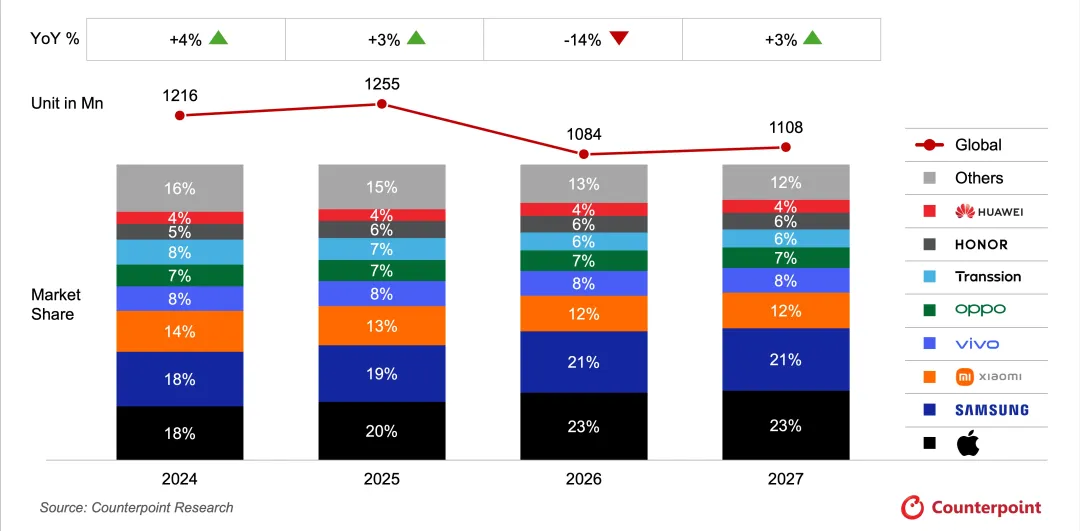
The real pressure will be felt by low-end brands and emerging markets. The supply of LPDDR4 memory is forecasted to shrink by more than 40% in 2026. Reflecting these rising component costs, average global smartphone wholesale prices jumped 14% year-on-year in the first quarter of 2026, and prices will continue to climb as older, cheaper component inventories are fully depleted. Counterpoint warns that entry-level devices priced below $150 USD are facing severe supply squeeze, putting these segments at risk of being phased out of the market entirely.
However, this slump won’t last forever. Counterpoint expects a strong recovery in 2028 as supply normalizes, pent-up demand is released, and geopolitical uncertainties stabilize. Furthermore, the early commercialization of 6G networks in pioneering markets like China, Japan, and South Korea by the end of the decade, alongside the maturation of AI-native hardware, will serve as powerful catalysts for a new upgrade cycle. Staying ahead of these smartphone market trends will be vital for OEMs navigating the next two years of supply volatility.