As local AI models keep getting larger, storage is starting to look less like a background component and more like a real performance bottleneck. Model files can easily run into tens of gigabytes, image-generation datasets may contain huge numbers of small files, and video-generation workflows can move terabytes of material in a single project. Lexar is trying to answer that problem with the Lexar NM1090 PRO 8TB, a flagship PCIe 5.0 SSD aimed squarely at high-end desktops, creator systems, and serious AI PC storage setups.
The version tested by IT Home is the top 8TB model. On paper, it is a very aggressive drive: up to 14,400MB/s sequential reads, up to 13,400MB/s sequential writes, 2,000K/2,100K IOPS for 4K random read/write performance, an 8GB dedicated DRAM cache, and enough capacity to hold large local model libraries without constantly shuffling files between drives.
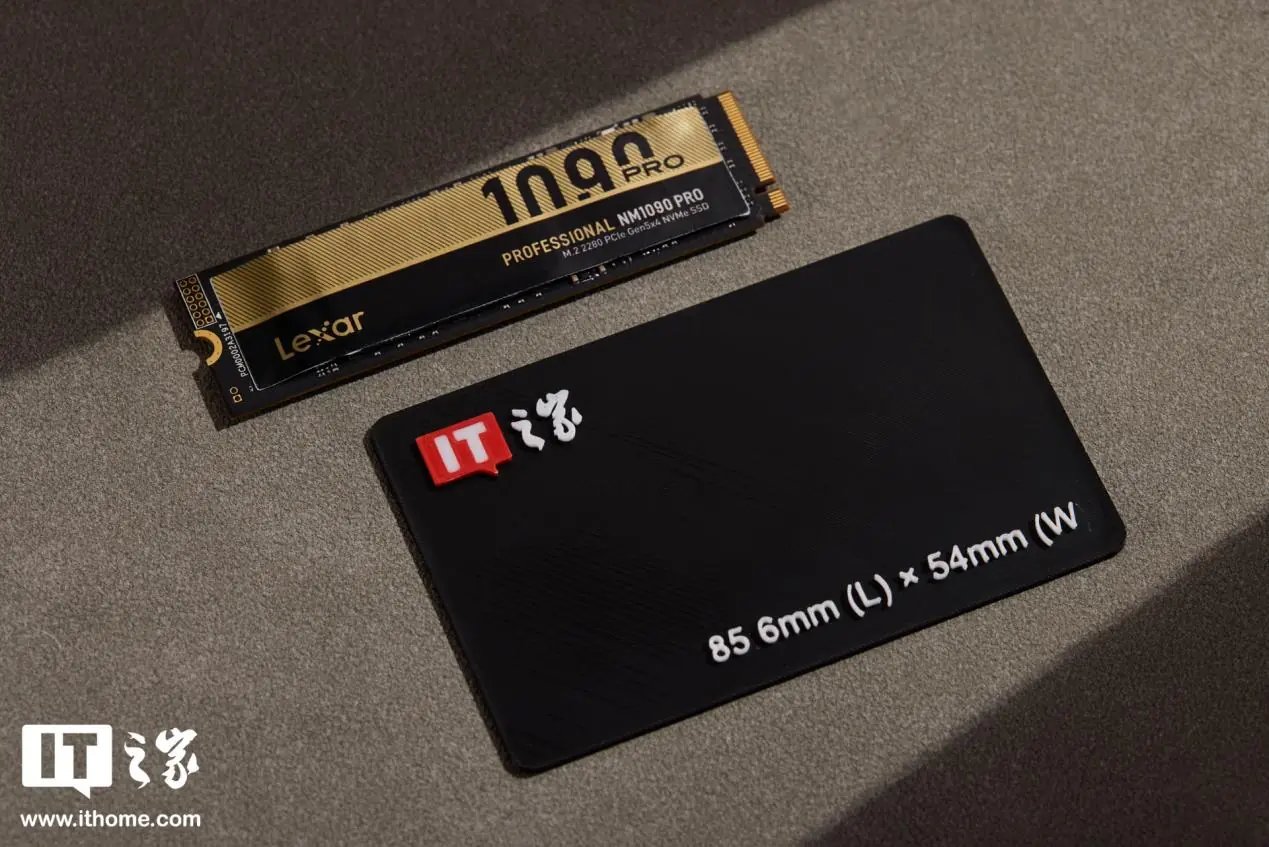
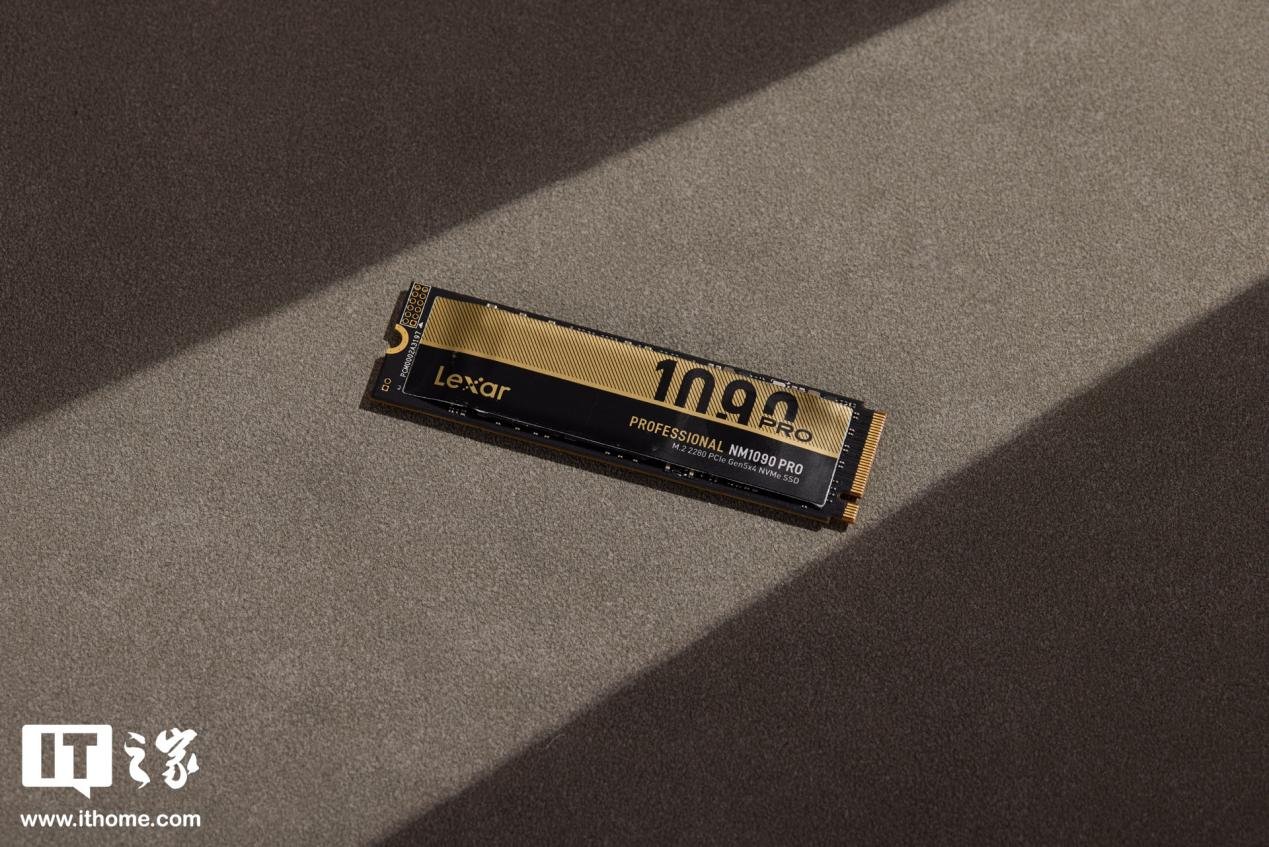
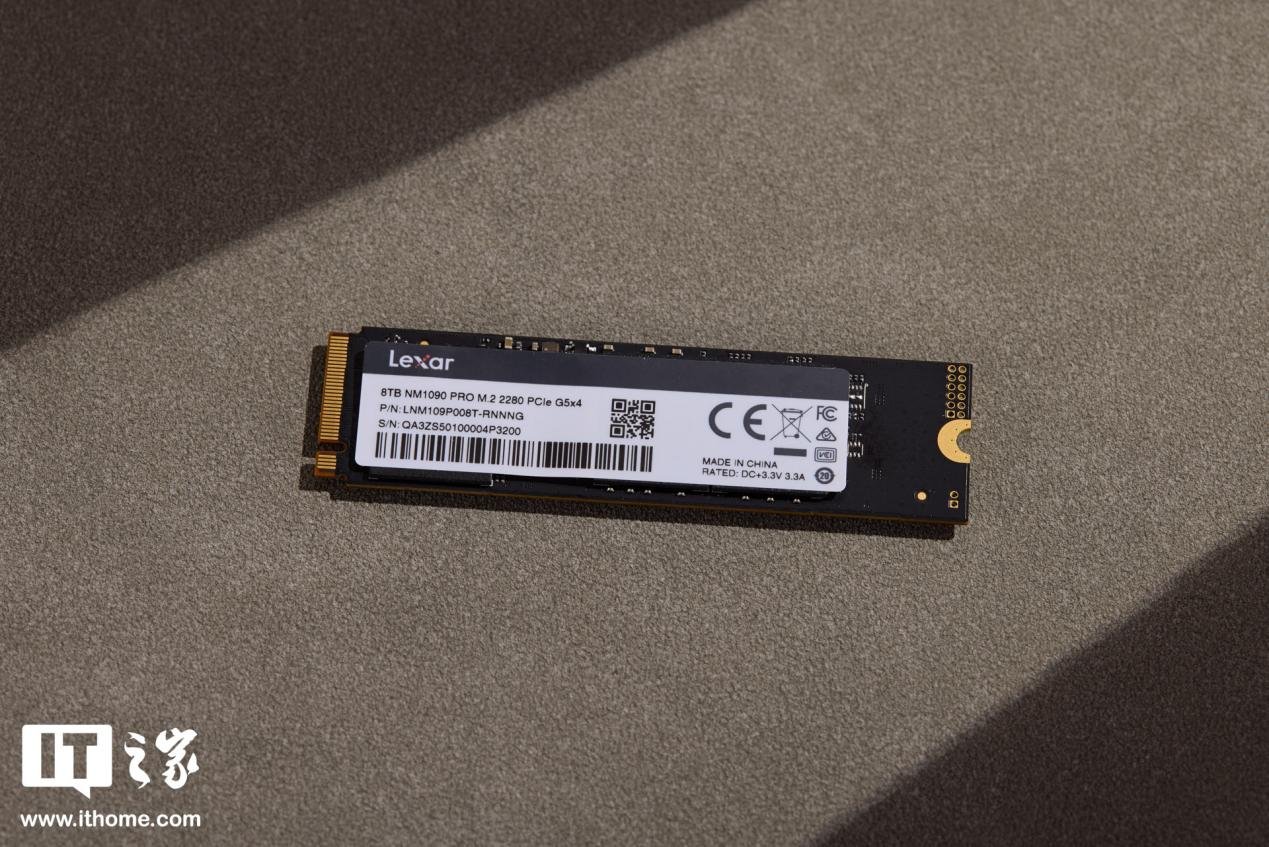
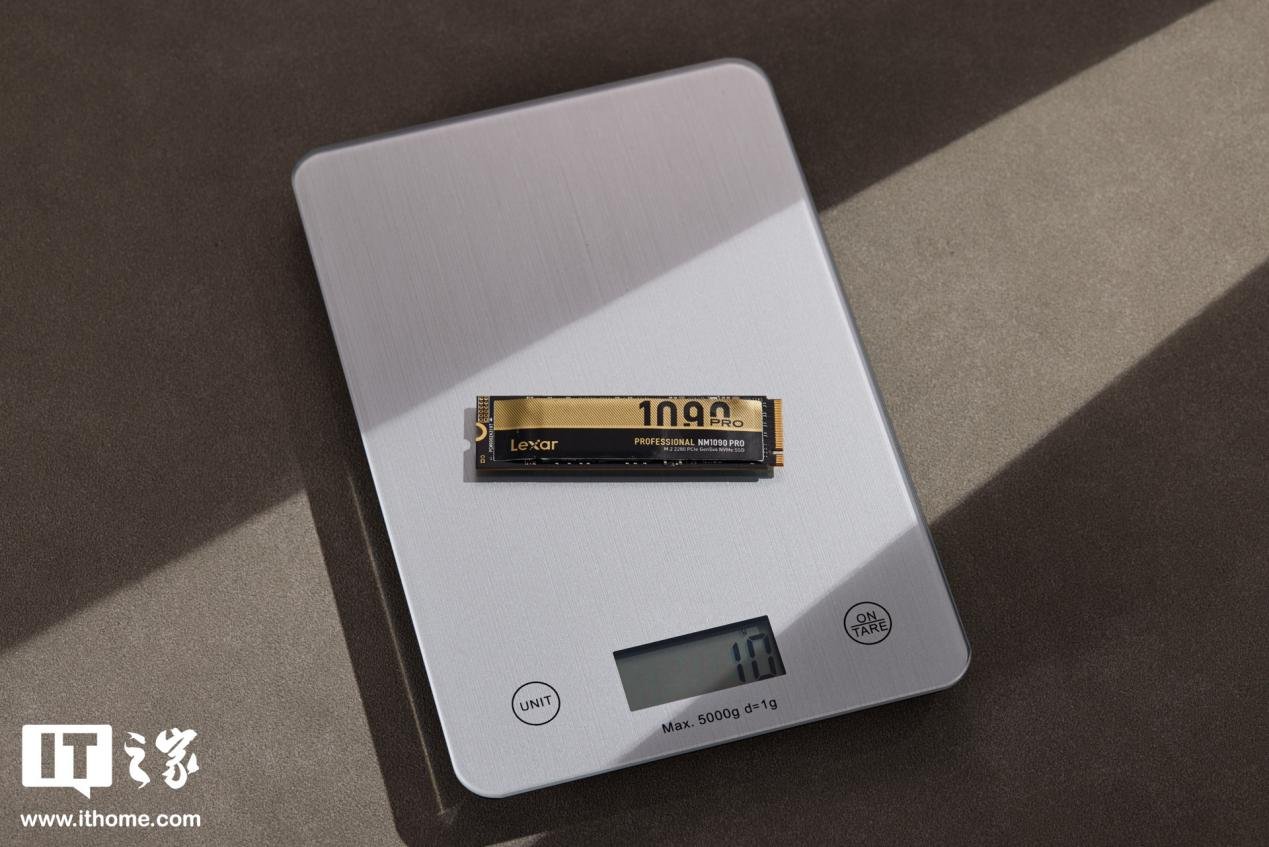
The drive keeps Lexar’s familiar black-and-gold styling. The front uses a professional-looking label made from a natural graphite composite material, which also provides some heat-dissipation support. Under the label is a high-conductivity, close-fitting, insulating double-sided adhesive layer. The back side carries the basic product information and certification label. Although the 8TB model uses a double-sided PCB, the label remains flat and tidy, which should help with heatsink contact inside a desktop motherboard or compatible system.
Physically, the NM1090 PRO uses the standard M.2 2280 format. With both sides of the PCB filled with components, it feels more substantial than a low-capacity SSD, but the total weight with the label is still about 10 grams. That is fairly light for an 8TB high-end drive.
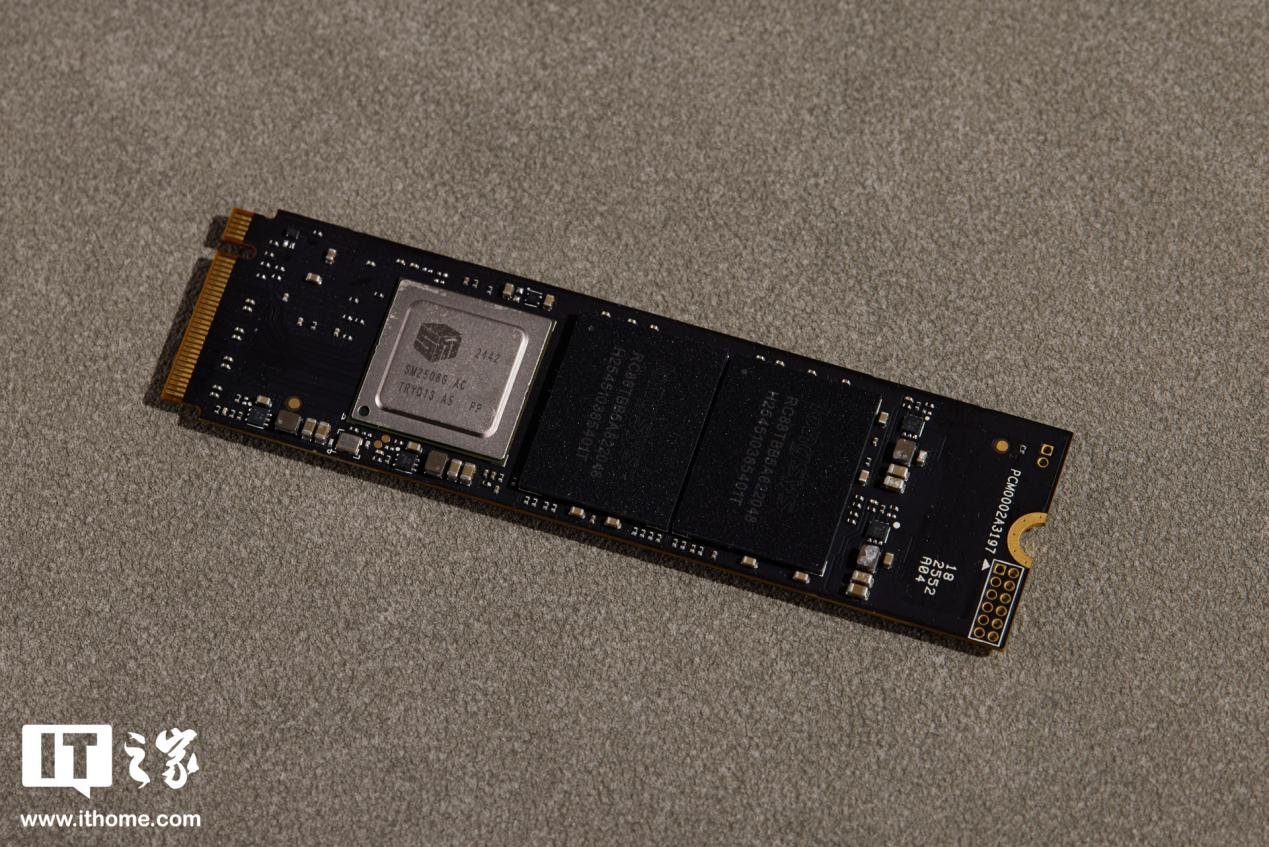
Under the front label, IT Home found the controller and two 2TB NAND packages. The NAND packages carry Longsys branding, which makes sense because Longsys is Lexar’s parent company. The specific marking is RC88TBB5A822048, identified as 3D TLC NAND and similar to the NAND previously seen in Lexar’s ARES 8TB SSD. The controller is Silicon Motion’s SM2508G, a flagship PCIe 5.0 x4 NVMe 2.0 controller built on TSMC’s 6nm EUV process and using an FC-BGA package.
That process node matters. PCIe 5.0 bandwidth can bring plenty of heat, and the source test notes that this 6nm controller can run significantly cooler than competing 12nm controllers at similar performance levels. Lexar cites a peak-temperature reduction of about 36% compared with 12nm alternatives. For a 14GB/s-class SSD, better controller efficiency is not just a spec-sheet detail; it can make sustained performance easier to maintain.
The back of the drive carries two more 2TB TLC NAND packages and an 8GB dedicated DRAM cache. That DRAM is used to store the FTL mapping table, helping reduce address-lookup latency and performance swings. In large-capacity SSDs, DRAM can be especially important because the drive has to manage a very large address space. Dynamic SLC caching is also used, allowing some NAND to work as faster SLC cache during burst writes before smoothly transitioning back to TLC direct writes.
Compared with many PCIe 5.0 SSD products that rely on HMB, the dedicated DRAM cache gives the Lexar NM1090 PRO 8TB a natural advantage in multitasking and random-I/O-heavy workloads. It does not need to borrow system memory bandwidth, and latency should be more predictable under pressure.
IT Home tested the SSD on Windows 11 Pro using a motherboard PCIe 5.0 x4 M.2 slot. The firmware version was Z0126B00. The nominal capacity was 8,193.58GB, while Windows reported about 7,630.87GB of usable space, or roughly 7.45TiB. In practical terms, this is a full 8TB-class drive rather than a capacity-light model.
In CrystalDiskMark with a 1GiB test file, five loops, and the drive empty, the NM1090 PRO reached 14,407MB/s sequential read speed, slightly above the official 14,400MB/s rating. Sequential write speed reached 13,516MB/s, also above the rated 13,400MB/s. Both numbers sit near the practical limit of a PCIe 5.0 x4 interface and are almost twice what high-end PCIe 4.0 SSDs usually deliver.
The small-file numbers were also strong. Single-queue 4K write performance reached 269MB/s, helped by the 8GB DRAM cache. That matters because many everyday and AI-related workloads are not just giant sequential transfers. They also involve lots of small reads and writes, metadata updates, project files, cache folders, and database-style access.
IT Home then ran dirty-drive pressure tests at 25%, 50%, 75%, and 90% fill levels. From empty to 90% full, sequential writes stayed between 13,455MB/s and 13,516MB/s, with less than 0.5% deviation. Sequential reads stayed between 14,120MB/s and 14,407MB/s. 4K Q1T1 random read and write variation stayed within 2%. In other words, this drive did not show the familiar “gets slow when full” behavior that still affects many high-speed SSDs.
That stability appears to come from two areas: the 8GB DRAM cache keeps the mapping table efficient across the full drive, and the 8TB capacity gives the controller more spare area and more room for garbage collection. For AI PC storage use, this is important. Users who download models, update datasets, and move project folders every day do not want a drive that feels fast only when it is freshly formatted.
Random performance is especially relevant for local AI work. Large model files benefit from sequential bandwidth, but image-generation libraries, training sets, document collections, and retrieval databases can involve thousands or millions of small files. Under a 32-queue, one-thread random load, the drive reached 868MB/s read and 673MB/s write bandwidth, matching the official 2,000K/2,100K IOPS class claims closely enough to support Lexar’s positioning.
CrystalDiskMark’s mixed 70% read / 30% write test was used to simulate a more realistic application-loading pattern. IT Home tested this mode with the drive empty and half full. The difference between the two runs was less than 2MB/s, effectively showing no meaningful drop. The 103MB/s mixed result is described as an upper-tier score for this class, suggesting that the SSD can deliver steady responsiveness in game loading, OS startup, and mixed desktop workloads.
HD Tune Pro was used for 200GB sequential read and write testing in zero-data mode. The numbers were lower than CrystalDiskMark, around 10,600MB/s rather than 14,400MB/s, but that is mostly because HD Tune is an older tool that does not fully squeeze modern PCIe 5.0 bandwidth. The more important point is that the 200GB read and write curves stayed flat, without a “fast first, slow later” pattern.
The tougher sustained-write test came from urwtest, which wrote across the entire drive to expose the real SLC cache behavior and TLC direct-write floor. For the first 50% of capacity, or about 3.8TB, write speed stayed around 3,700MB/s to 3,900MB/s. That suggests the dynamic SLC cache has a very large pool to work with on the 8TB version.
From 50% to 97% full, write speed gradually moved from about 3,000MB/s down to roughly 1,900MB/s instead of falling off a cliff. The final full-drive average write speed was 1,905MB/s. For comparison, many flagship PCIe 4.0 drives average roughly 1,000MB/s to 1,500MB/s in full-drive write tests. The Lexar NM1090 PRO 8TB is clearly operating in a higher sustained-performance tier.
For real AI workflows, that means massive dataset imports, model backups, or large video-generation project transfers can keep moving quickly even after the easy cache window is gone. IT Home estimates that writing the entire 8TB drive could be completed in about one hour, which is impressive for this capacity class.
Another full-drive read test showed an average sequential read speed of 10,642MB/s, almost identical to HD Tune’s 10,653MB/s result. Two independent tools landing in the same range makes the sustained-read data more credible. When the cache was fully exhausted, TLC direct-write speed still held above 1GB/s at 1,071MB/s. At a 64-queue depth, 4K random reads reached 120,700 IOPS, while 4K random writes approached 50,000 IOPS. That gives the drive useful headroom for high-concurrency workloads such as databases, virtualization, or local inference systems doing a lot of random access.
Benchmarks are helpful, but IT Home also tested a real local AI scenario: loading a Gemma4:31b model file of about 20GB through Ollama. The same platform was tested with a PCIe 4.0 4TB flagship SSD and the NM1090 PRO 8TB. Before each run, the Ollama service was stopped and the system file cache was cleared, forcing the model data to be loaded from the SSD rather than memory.
The result was straightforward. The NM1090 PRO loaded the model in 47 seconds, while the PCIe 4.0 drive needed 73 seconds. That cuts more than one-third of the waiting time. If someone switches models five times a day, the savings may be only a couple of minutes. But for developers repeatedly comparing models, testing prompts, or moving between local workloads, the difference can add up quickly.
IT Home also tested a local knowledge-base setup using Ollama plus AnythingLLM. The system imported 99 documents and used the Gemma4:31b local model for content retrieval. The NM1090 PRO completed the task in about 28.2 seconds, while the PCIe 4.0 SSD took around 36.6 seconds. The improvement was clear, though not purely a matter of sequential bandwidth. The drive’s DRAM cache and random-access behavior seem to help just as much as raw PCIe 5.0 throughput.
Lexar’s DiskMaster utility was also tested. The version used by IT Home was V1.1.8. It can display drive capacity, interface details, temperature, and health status. Idle temperature was around 43°C to 46°C. The S.M.A.R.T. section exposed 16 sensor parameters, including critical warning flags, composite temperature, available spare space, lifetime usage percentage, read/write unit counters, and unsafe shutdown counts. All reported values were OK during testing.
The utility also includes one-click performance testing. IT Home measured 14,408.80MB/s sequential read, 13,507.44MB/s sequential write, 7,992.56MB/s random read, and 8,605.69MB/s random write, which closely matched the CrystalDiskMark results. Other built-in tools include secure erase, disk-to-disk migration, fault scanning, and firmware update support. The only complaint in the source test was that the app window scales a little too large on 4K high-DPI displays.
Heat is always a concern with PCIe 5.0 SSDs. During the full test process, IT Home monitored NM1090 PRO temperatures. Idle temperature was around 40°C. During the near-8TB continuous-write urwtest run, the drive stayed below 74°C. For a PCIe 5.0 x4 flagship drive with 14,000MB/s-class throughput, that is a solid thermal result.
The final conclusion is that the Lexar NM1090 PRO 8TB is not just chasing headline speed. It combines very high sequential bandwidth, strong random performance, a large DRAM cache, a huge usable capacity, and surprisingly consistent behavior when the drive is heavily filled. The 6nm controller also helps keep the usual PCIe 5.0 heat issue under better control.
For a typical office PC, this is more SSD than most people need. For a workstation, creator build, or local AI development machine, though, the story is different. If your workflow involves large model libraries, local RAG databases, image datasets, high-resolution media, or constant multi-terabyte transfers, the Lexar NM1090 PRO 8TB looks like one of the few drives that can balance speed, capacity, and stability in the same package.