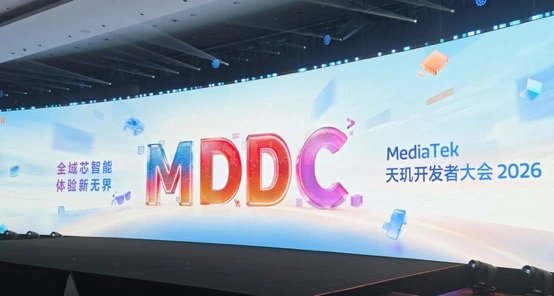
MediaTek used its Dimensity Developer Conference 2026 to make a bigger point than just launching another set of tools. The company is arguing that the next phase of mobile AI won’t be defined by isolated benchmark wins, but by how well chips, operating systems, apps, devices, and cloud resources work together to deliver Agentic AI experiences that actually feel useful in daily life.
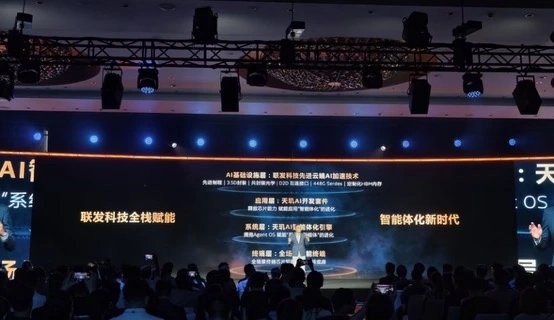
At the event, MediaTek introduced Dimensity AI Agentic Engine 2.0 and the Dimensity AI Development Kit 3.0, while also showing how those technologies connect with partners including OPPO, Xiaomi, and Transsion. The message was fairly clear: MediaTek no longer wants to be seen only as a smartphone chip supplier. It wants to position itself as a full stack enabler for the broader Dimensity ecosystem.
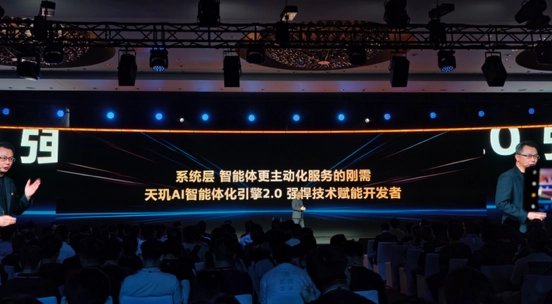
That shift matters because AI competition is changing fast. Raw compute still matters, of course, but MediaTek’s pitch is that user experience now depends just as much on system coordination, cross app execution, and smooth movement across phones, tablets, cars, glasses, and other connected devices. In that framing, AI becomes less about one impressive demo and more about whether a device can observe context, understand intent, and act across services with minimal friction.
To support that idea, MediaTek laid out a four layer architecture for the agent era. At the infrastructure layer, it talked about cloud side AI acceleration built around advanced process technology, 3.5D packaging, co packaged optics, die to die interconnects, and customized HBM memory. At the application layer, the company is using its AI development kit to expose lower level capabilities so developers can build smarter apps without fighting the platform. Between those sits the system layer, where the agent engine is meant to provide a unified runtime and interface for hardware access. On the device side, MediaTek says its chip portfolio already spans phones, AI glasses, vehicles, and smart home categories, giving it a broader base for cross device deployment.
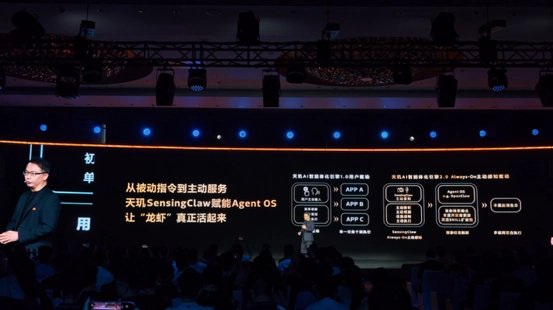
One of the most notable ideas presented at the conference was SensingClaw, a low power sensing technology designed to support always on awareness. MediaTek says this can help hardware makers build devices that don’t just wait for a wake word, but continuously observe signals from sensors and react more proactively to what users are doing. In plain terms, that’s the kind of capability needed if AI is going to feel more like an assistant and less like a chatbot trapped behind a button press.

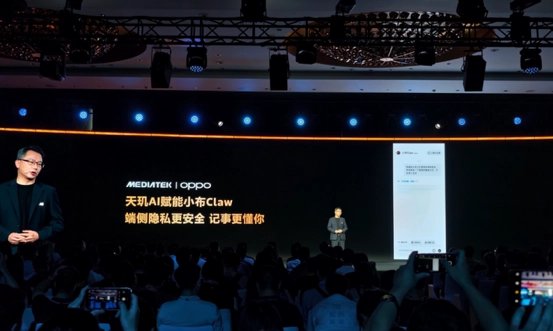
The company also used partner demos to show what that could look like in practice. OPPO’s implementation focused on local privacy and habit memory, Xiaomi’s version emphasized seamless task handoff between devices, and Transsion’s take highlighted proactive service powered by always on sensing. Whether each example scales well in the real world remains to be seen, but together they show the direction MediaTek is pushing: cross device AI that can move beyond single app interactions.
On the developer side, MediaTek spent a lot of time talking about efficiency improvements. The Dimensity AI Development Kit 3.0 now supports visual deployment for LVM models, with a move from command line workflows to GUI based modular configuration. According to the company, that can raise deployment and tuning efficiency by about 50 percent. It also introduced a low bit compression toolkit that MediaTek says can improve compression efficiency by up to 58 percent at similar quality, plus an eNPU toolkit meant to cut power use for light always resident AI workloads by as much as 42 percent.
Another addition is Dimensity AI Partner, which MediaTek described as a conversion assistant for automatically migrating models to the platform. The claim here is especially aggressive: local large language model deployment time can drop by up to 90 percent. Numbers like that always deserve a little caution until developers have spent time with the tools themselves, but the broader strategy is easy to understand. MediaTek is trying to lower the cost, complexity, and time required to bring AI models onto device.
The conference floor also gave the company a chance to show how those building blocks could translate into end user features. Meitu demonstrated on device portrait video restoration using MediaTek’s device cloud collaboration approach, while also offering AI editing SDKs that can be installed quickly. Elsewhere, MediaTek and StepFun showed visualized deployment of the ACE Step music model for local creative workflows. There was also an AI glasses demo built around a Qwen3 Omni multimodal model running fully on device, meant to highlight low latency, stronger privacy, and richer native multimodal interaction.
Taken together, the event suggested that MediaTek sees the future of Agentic AI as an ecosystem problem rather than a single chip problem. Its bet is that developers and device brands need a shared foundation across hardware, software, and model deployment if AI is going to scale beyond flashy features into something persistent and practical. That’s an ambitious pitch, but it’s a more grounded one than pretending the next wave will be won by specs alone.