China’s telecom regulator says the country’s communications industry kept expanding through the first four months of 2026, with 5G base stations and gigabit broadband networks continuing to roll out at scale. According to the latest operating report from the Ministry of Industry and Information Technology, the total number of 5G base stations nationwide reached 5.009 million by the end of April, up 171,000 from the end of last year. That means 5G sites now account for 38.7% of all mobile base stations in the country, up another 0.5 percentage points from the end of the first quarter.
The base-station count is also well ahead of the same point last year, when the country had 4.439 million 5G sites in service. In practical terms, the latest figure marks the first time China has moved past the 5 million threshold, which underscores how aggressively the country is still building out next-generation mobile coverage.
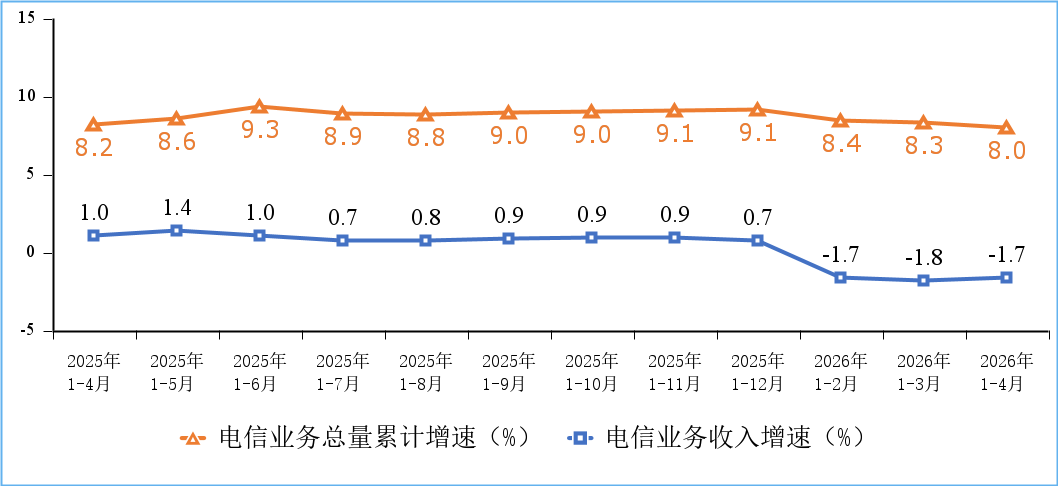
The ministry also said total telecom service revenue for the January-to-April period came in at 594.1 billion yuan, down 1.7% year over year. At constant prices, though, telecom business volume still rose 8%, suggesting network use and service demand continued to climb even as revenue growth stayed under pressure.
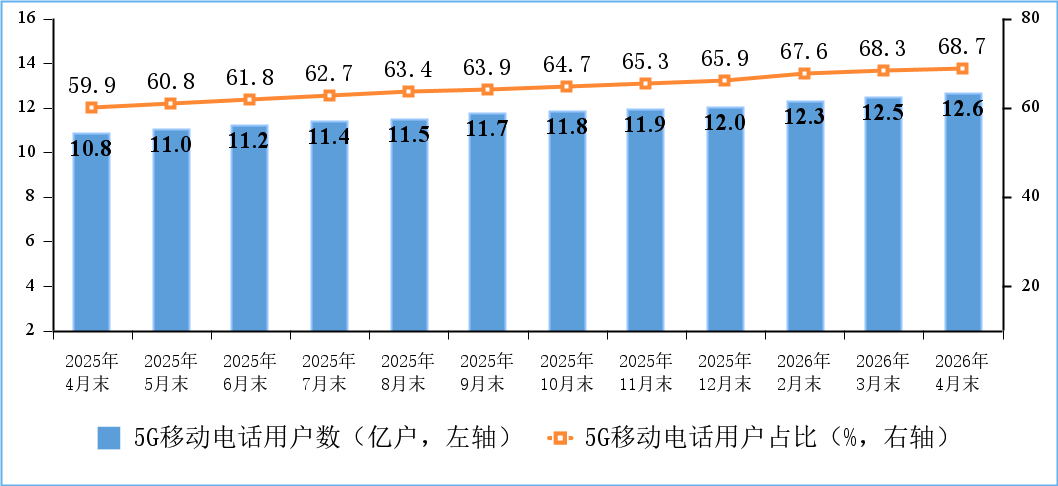
On the subscriber side, 5G mobile users kept growing quickly. By the end of April, the three major basic telecom operators plus China Broadcasting Network had a combined 1.838 billion mobile phone users, an increase of 10.92 million from the end of 2025. Within that total, 5G mobile users reached 1.262 billion, up 57.58 million since the start of the year. That means 68.7% of all mobile users in the country are now on 5G-capable plans.
Fixed broadband also kept shifting upward. China had 698 million fixed broadband subscribers by the end of April, up 7.271 million from year-end. Of those, 253 million were using broadband connections rated at 1,000Mbps or above, an increase of 14.25 million in just four months. Gigabit-tier users now make up 36.2% of all fixed broadband subscribers, 1.7 percentage points higher than at the end of last year. Users on 100Mbps or faster connections reached 667 million, equal to 95.5% of the total subscriber base.
The report also showed rapid growth in connected devices and media access. Mobile IoT terminal users climbed to 2.976 billion, up 87.63 million from the end of 2025, while internet TV users reached 410 million.
Usage trends were mixed. Mobile internet traffic stayed strong, with cumulative data usage hitting 142 billion GB in the first four months of the year, up 18.5% from a year earlier. Mobile internet users totaled 1.624 billion by the end of April, and average monthly mobile data use per household reached 23.17GB in April, up 13.5% year over year and 0.13GB higher than at the end of last year. Traditional voice and messaging services continued to slide, though: outgoing mobile call duration fell 5.8%, fixed-line outgoing call duration dropped 21.5%, mobile SMS volume declined 5.8%, and SMS revenue fell 11.5%.
From a network-construction standpoint, the broadband access base also kept expanding. China had 1.27 billion broadband access ports nationwide by the end of April, up 18.94 million from the end of 2025. Fiber access ports accounted for 1.23 billion of that total, or 96.6%. The number of 10G PON ports capable of supporting gigabit network services reached 32.35 million, up another 726,000 since the start of the year.
Regional adoption remained broad-based. The ministry said 5G penetration reached 69.4% in northeast China, above the national average. The figure came in at 69.5% in central China, 68.6% in western China, and 68.1% in eastern China. For gigabit broadband, central and western regions led with penetration rates of 36.9% and 37.6%, ahead of eastern China at 35.6% and the northeast at 30.7%. Every region posted double-digit growth in mobile internet traffic, with eastern and northeastern China growing 20.1% and 20.4%, respectively.