Omdia says the Middle East smartphone market got off to a weak start in 2026, and the research firm now expects the region to decline by 22% for the full year if current pressure points continue.
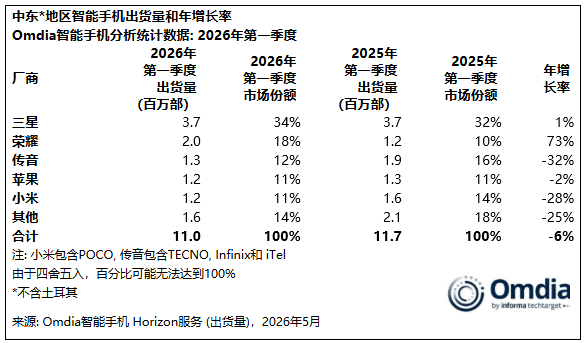
In its latest report, Omdia said first-quarter smartphone shipments in the Middle East, excluding Turkey, fell 6% year over year to 11 million units. The firm said vendors and channels had stocked up ahead of Ramadan and around new product launches, but real sell-through at retail stayed soft as shoppers remained cautious about replacing their phones.
Omdia also pointed to another major headwind: rising memory costs. According to the report, that inflation has pushed smartphone pricing higher across both new and older product lines, leaving brands with less room for aggressive promotions. The firm added that geopolitical tensions near the end of the quarter further disrupted regional supply chains and weighed on consumer confidence.
The vendor ranking in the report shows Samsung still in first place with 3.7 million units shipped and a 34% market share, up 1% year over year. Honor was the biggest standout, reaching 2 million units and an 18% share after a 73% increase. Transsion shipped 1.3 million units for a 12% share, while Apple and Xiaomi each landed at 1.2 million units and 11% of the market.
Omdia said Samsung kept expanding its lead thanks in part to the Galaxy S26 lineup and an updated A-series portfolio. Honor, meanwhile, became the region’s second-largest smartphone brand in the first quarter of 2026 for the first time, with growth tied to stronger retail execution, broader channels, and improved brand visibility.
By contrast, Transsion and Xiaomi were said to be under heavier pressure in the entry-level segment, where weaker spending power and reduced promotional activity dragged replacement demand lower. Apple, on the other hand, continued to show resilience in the premium tier, and Omdia highlighted the iPhone 17 Pro Max as one of the region’s leading shipment drivers.
With pricing pressure, selective supply allocation, and macro uncertainty still hanging over demand, Omdia now expects the broader regional market to stay under strain through the rest of the year. If that forecast holds, 2026 will be a notably harder year for smartphone vendors in the Middle East than many had hoped at the start of the product cycle.