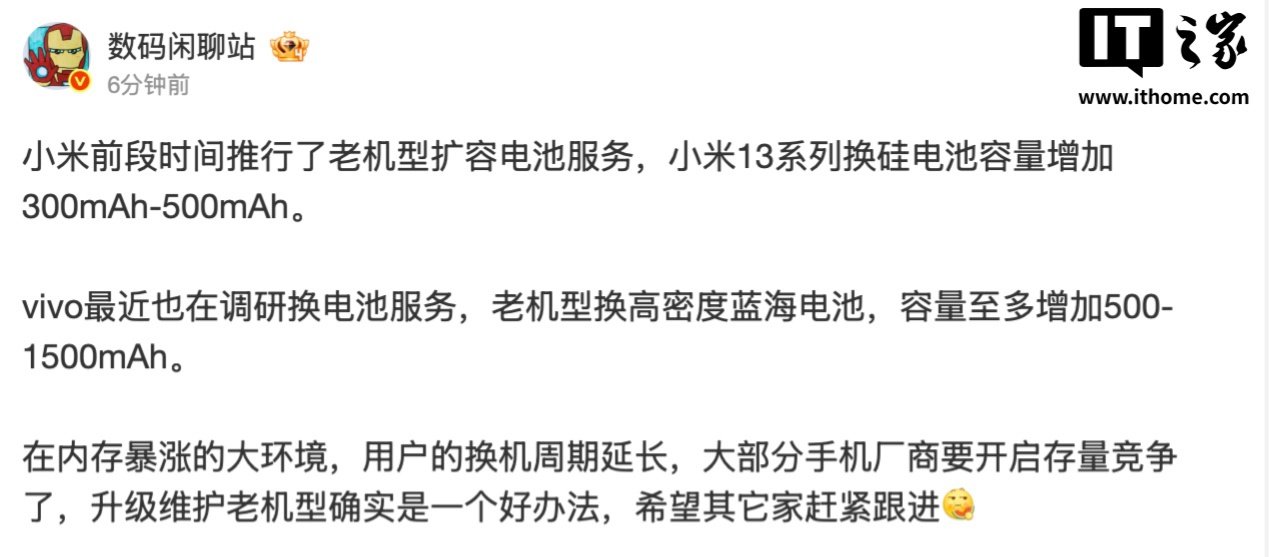
vivo battery replacement services may be headed in a more ambitious direction, according to a new leak shared by tipster Digital Chat Station. The claim is that vivo has been researching battery replacement options for older models that would not just restore original endurance, but actually increase capacity by using newer high-density battery technology.
The most eye-catching part of the report is the potential size of the upgrade. The leak says some older devices could gain roughly 500mAh to 1500mAh after a battery swap, which would make this more than a routine maintenance program. If that turns out to be accurate, the idea would be simple: keep existing phones in service longer while giving users a tangible everyday benefit instead of only replacing a worn-out part with an identical one.
That thinking lines up with broader market conditions. As the source puts it, users are holding onto phones longer, and manufacturers are being pushed into a more competitive installed-base market rather than relying only on frequent hardware upgrades. In that environment, a meaningful battery upgrade for older devices could become a practical way to improve customer retention and extend product life cycles.

IT Home also points to Xiaomi as an existing example of how this strategy can work. Xiaomi has already launched battery upgrade services across the Xiaomi 13 lineup, charging 189 yuan in total, including 149 yuan for the upgraded battery and 40 yuan for labor. Reported capacity increases include the Xiaomi 13 moving from 4500mAh to 4850mAh, the Xiaomi 13 Pro from 4820mAh to 5361mAh, and the Xiaomi 13 Ultra from 5000mAh to 5500mAh.
Xiaomi executives have previously suggested that users who are not planning to replace their phones soon may benefit from waiting for battery service options, since some models can now receive replacement packs with larger capacities than the originals. That context makes the rumored vivo move feel less isolated and more like the start of a broader service trend across Chinese phone makers.
For users with older phones, this kind of program would be easier to appreciate than many headline-grabbing software announcements. Better battery life is immediate, measurable, and useful every day. For now, though, the vivo plan remains at the research stage, and there is no official launch timeline or model list yet. Still, the idea is notable because it suggests after-sales service could become a bigger part of how smartphone brands compete in the next upgrade cycle.