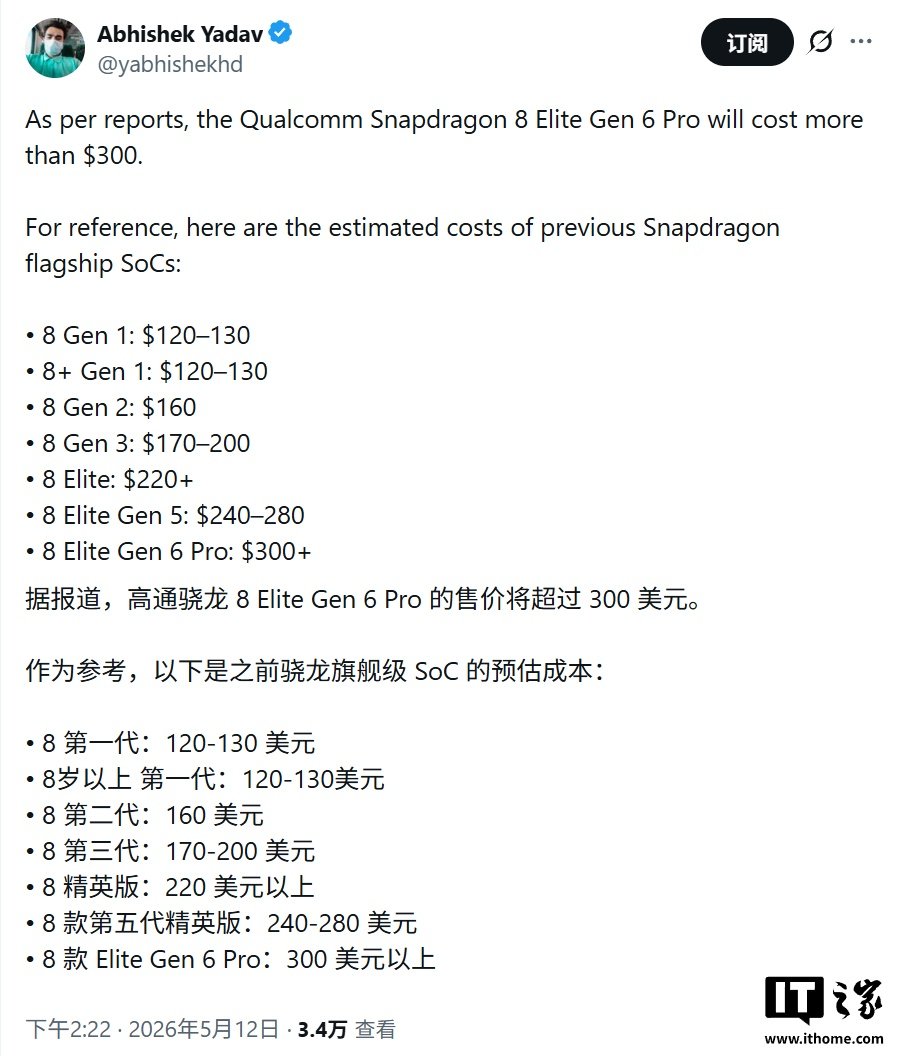
A fresh leak suggests Qualcomm’s next top-end mobile platform may come with a much steeper price than anything in the recent Snapdragon lineup. According to a post from tipster @yabhishekhd, the per-chip cost of the Snapdragon 8 Elite Gen 6 Pro could move past $300 and may even land around $330, a level that would put real pressure on the pricing of upcoming ultra-premium Android phones.
The report compares that estimate with earlier flagship Snapdragon generations and shows how sharply costs may have climbed in just a few years. Snapdragon 8 Gen 1 and 8+ Gen 1 were both said to sit around $120 to $130 per chip. Snapdragon 8 Gen 2 moved closer to $160, while Snapdragon 8 Gen 3 was placed in roughly the $170 to $200 range. The current Snapdragon 8 Elite generation was pegged at about $220, and the fifth-generation Elite model was estimated at roughly $240 to $280. If the sixth-generation Pro model really reaches $330, it would mark another major jump at the top end of the market.
For phone makers, the application processor is already one of the most expensive core parts in a flagship device. If Qualcomm’s next premium silicon really gets that costly, brands may struggle to absorb the increase on their own. In practical terms, that means part of the added cost could be passed along to buyers, especially on so-called Ultra devices where brands are already loading in more expensive camera systems, displays, memory, and storage.
Android Headline points to TSMC 2nm manufacturing as the likely main reason behind the higher pricing. The leak ties the cost increase to TSMC’s advanced N2P process, which is expected to offer higher performance but also comes with a very expensive manufacturing bill. One claim in the report says a single 2nm wafer may cost around $30,000, or close to double the price of the previous generation. That kind of increase would naturally raise the barrier for mass production on cutting-edge chips.
Beyond the raw price hike, the more interesting part may be Qualcomm’s product strategy. The report says the company could split its 2026 flagship platform into two versions by the end of the year. A standard SM8950 variant would target mainstream flagship phones and support LPDDR5X memory alongside an Adreno 845 GPU. The more premium SM8975 Pro version would be positioned for Ultra-class devices, with support for LPDDR6, UFS 5.0, a stronger Adreno 850 GPU, and potentially more graphics memory.
If that roadmap holds, Qualcomm wouldn’t just be selling a faster chip. It would be creating a more visible performance tier inside the Android flagship market, where some brands ship a standard high-end phone while reserving the absolute best memory, storage, and graphics stack for their top Ultra model. That’s a familiar playbook in phones, but a pricier Snapdragon 8 Elite Gen 6 Pro could make the gap between regular flagships and full-spec Ultra devices even wider.